
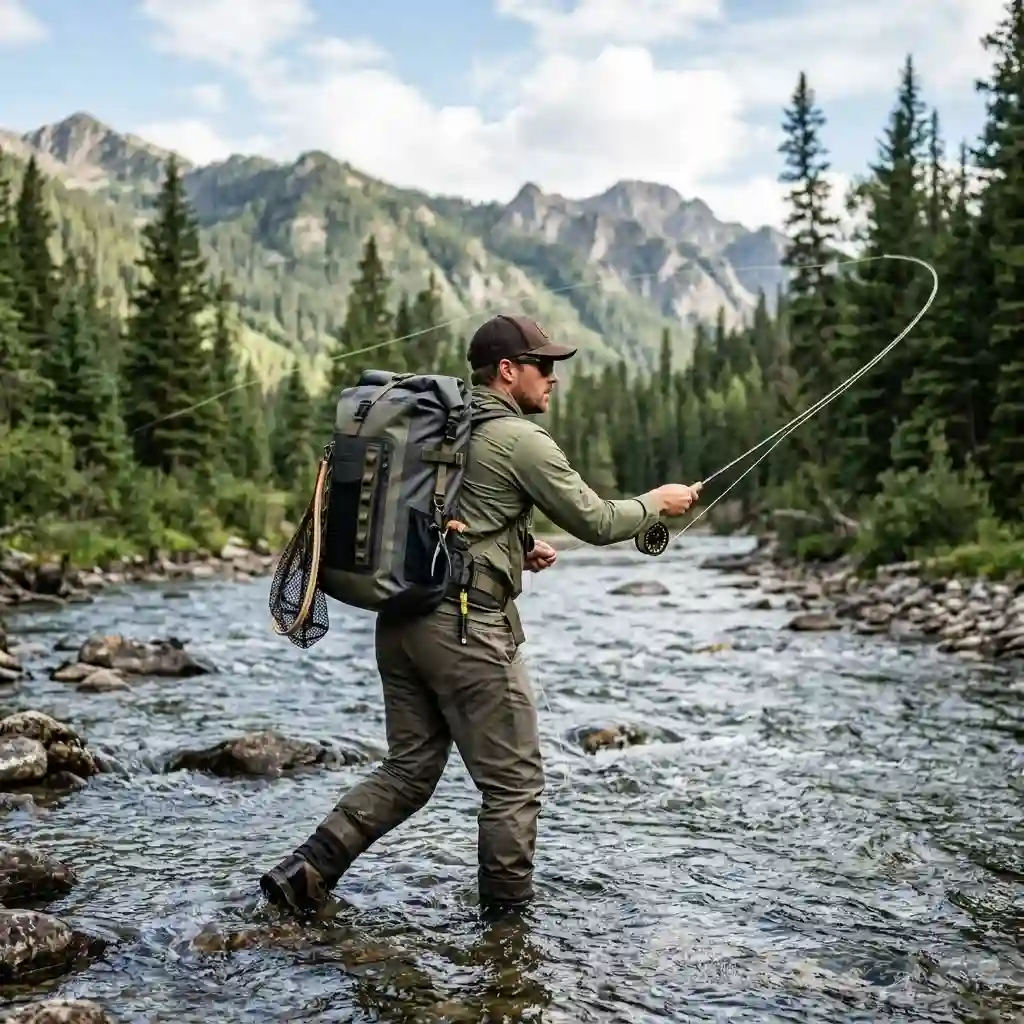
If there is one piece of gear that has drastically transformed how I approach my time on the water over the last decade, it is the modern waterproof fishing backpack. Gone are the days of stuffing your expensive DSLR camera, phone, and dry socks into a flimsy kitchen trash bag, praying that your canvas rucksack doesn’t take an accidental swim. What is a waterproof fishing backpack? In technical terms, it is a specialized carrying system constructed from impermeable materials—usually welded TPU or PVC—designed specifically to withstand prolonged exposure to rain, splash, or complete submersion while offering specialized tackle organization.
In my years of field testing gear everywhere from the torrential downpours of the Pacific Northwest to the salty, corrosive surf of Montauk, I’ve realized that the spec sheets only tell about ten percent of the story. You see a tag that says “100% waterproof,” but what does that actually mean when you take a spill while rock-hopping at high tide? Most reviewers claim any roll-top dry bag will do the trick, but in practice, I found that true fishing-specific backpacks require a delicate balance of ergonomic suspension, quick-access exterior rigging, and internal tackle compartmentalization.
The industry has shifted massively heading into 2026. We are seeing self-healing zipper technologies and eco-friendly TPU coatings replacing the rigid, easily cracked PVC of the past. As an angling consultant, my goal here is to strip away the marketing fluff. We are going to dive deep into the engineering, the practical applications, and the hidden quirks of the best gear on the market today.
Quick Comparison: Top Contenders at a Glance
| Product Model | Best For | Closure System | Key Material | Price Range |
| Yeti Panga 28L | Hardcore Wading & Kayaking | Hydrolok Zipper | High-Density Nylon | Over $250 |
| Simms Dry Creek Z | Fly Fishing & Ergonomics | TRU Zip Self-Healing | 300D Ripstop | $200 – $250 |
| Grundéns RumRunner | Surfcasting & Saltwater | Roll-Top | 500D PVC Tarpaulin | $100 – $150 |
| KastKing Karis | Organized Tackle Storage | Roll-Top + Buckles | 420D TPU | $80 – $120 |
| Piscifun Dry Bag Pack | Budget-Conscious Anglers | Roll-Top | 500D PVC | Under $60 |
Looking at the comparison above, the Yeti Panga clearly dominates the premium, fully submersible category, but if lightweight maneuverability is your priority, the Simms model justifies its price tag with superior ergonomic suspension. Budget buyers should note that while the Piscifun pack sacrifices internal tackle organization and long-term durability, its extremely low price point makes it an unbeatable entry-level option for casual weekend trips.
💬 Just one click — help others make better buying decisions too!😊
[addtoany]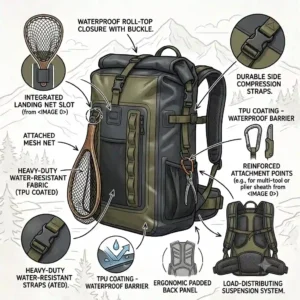
Top 5 Waterproof Fishing Backpacks — Expert Analysis
1. Yeti Panga 28L Waterproof Backpack
The Yeti Panga 28L is essentially a portable vault for your gear, distinguished by its absolutely bombproof Hydrolok zipper system. Built with ThickSkin Shell material (high-density nylon and thick TPU lamination), this bag resists punctures from stray hooks and jagged rocks like armor. The EVA molded back panel ensures structural rigidity, meaning it won’t slump over when you set it down on a muddy bank.
In my experience, the sheer rigidity of this bag is both its greatest strength and its primary weakness. The Hydrolok zipper is stiff—requiring genuine physical effort to open—but that tension is exactly what ensures not a single drop of water gets in when you accidentally drop it in a 4-foot river pool. This bag is explicitly for the hardcore kayaker or deep-wading fly angler who simply cannot afford for their expensive camera or drone to get wet. If you just need something for a light drizzle on a pier, this is overkill.
Customer feedback consistently praises the bag’s indestructible feel, though many note the lack of internal pockets requires you to buy separate packing cubes.
-
Pros: 100% submersible; puncture-resistant shell; excellent lash points.
-
Cons: Very expensive; zipper requires heavy maintenance (lubrication).
-
Price Range & Verdict: Sitting well over $250, it is a steep investment, but the lifetime protection of your electronics makes it a no-brainer for serious professionals.
2. Simms Dry Creek Z Fishing Backpack
The Simms Dry Creek Z perfectly bridges the gap between rugged waterproofness and all-day wearing comfort, highlighted by its innovative TRU Zip toothless closure. It utilizes a 300D polyester ripstop with an outside PU coating and inside TPU lamination. What does that mean for you? It means the bag is significantly lighter than the Yeti, reducing shoulder fatigue on those 10-mile hike-in backcountry trips.
What surprised me most during use was the self-healing nature of the TRU Zip. Unlike traditional toothed zippers that can permanently break if a grain of sand gets lodged in them, this toothless system glides smoothly and seals perfectly. I consider this the absolute best option for fly fishers. The exterior features a net D-ring and dedicated tool docking stations, keeping your nippers and forceps accessible without compromising the waterproof seal.
Reviewers frequently highlight the incredible comfort of the cushioned, breathable shoulder straps, though a few mention the 25L capacity feels slightly cramped for multi-day trips.
-
Pros: Exceptionally lightweight; toothless waterproof zipper; fly-fishing specific attachments.
-
Cons: Lower denier rating makes it slightly less abrasion-resistant; premium price.
-
Price Range & Verdict: In the $200-$250 range, this is the gold standard for anglers who prioritize ergonomic comfort as much as water resistance.
3. Grundéns RumRunner 30L Backpack
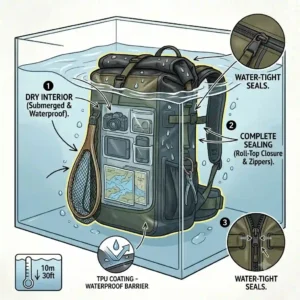
When it comes to battling the highly corrosive environment of the open ocean, the Grundéns RumRunner 30L stands out with its heavy-duty 500D PVC tarpaulin construction and RF-welded seams. The roll-top closure system is old-school but incredibly effective. It features a moisture-wicking back panel and two external water bottle pockets.
I’ve dragged this pack across barnacle-covered jetties, and the PVC tarpaulin just laughs off the abuse. The real-world application here is brilliant: roll-tops never jam from salt crystals. If you are a surfcaster getting hammered by ocean spray, a mechanical zipper will eventually fail without meticulous cleaning. The RumRunner avoids that failure point entirely. However, the spec sheet won’t tell you this: you must roll it at least three tight times to achieve a waterproof seal.
Customer reviews love the cavernous interior and ruggedness, but often point out that retrieving items from the very bottom of the main compartment is frustratingly difficult.
-
Pros: Immune to saltwater zipper corrosion; highly abrasion-resistant; great capacity.
-
Cons: “Black hole” interior design; requires careful rolling to ensure seal.
-
Price Range & Verdict: Floating in the $100-$150 range, it offers phenomenal commercial-grade durability for the saltwater enthusiast.
4. KastKing Karis Waterproof Backpack
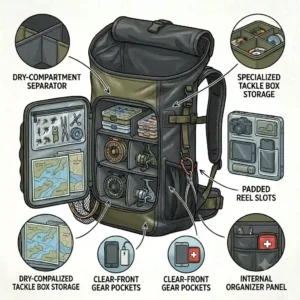
The KastKing Karis tackles the biggest problem with dry bags: organization. It boasts a 420D TPU construction and features a unique semi-rigid bottom compartment specifically designed to hold 3600-size tackle trays. It uses a combination of a roll-top main compartment and water-resistant (not submersible) exterior accessory pockets.
What most buyers overlook about this model is the ingenious weight distribution. By placing the heavy tackle trays at the very bottom in a structured compartment, the bag maintains a low center of gravity. This translates to better balance when you are rock-hopping. It’s tailored for the highly organized bass angler who wants the protection of a dry bag without giving up the rapid tackle-swapping capability of a traditional canvas pack.
Feedback generally applauds the dual-purpose design, though some users note that the exterior pockets will let water in during a heavy downpour.
-
Pros: Dedicated tackle box storage; stands upright on its own; excellent price-to-feature ratio.
-
Cons: Exterior pockets are merely splash-proof; slightly bulky profile.
-
Price Range & Verdict: Priced in the $80-$120 range, it hits the sweet spot for organized anglers who refuse to pay premium brand markups.
5. Piscifun Waterproof Dry Bag Backpack
For the weekend warrior, the Piscifun Waterproof Dry Bag Backpack delivers essential functionality through a classic 500D PVC roll-top design without breaking the bank. It comes with adjustable padded straps, a transparent waterproof phone pouch, and a simple bungee cord lattice on the exterior for wet rain gear.
In my field tests, I found that while the suspension system is basic, it gets the job done for short trips. The PVC is thick and durable. My expert advice? This is the perfect “trunk bag.” Keep it rolled up in your car, and when a pop-up thunderstorm threatens your afternoon trip, throw your valuables inside. It lacks the internal structure and heavy-duty waist belts of the premium options, meaning a heavy load will pull uncomfortably on your shoulders after a few hours.
Customers praise its immense value and reliable waterproofing, but frequently criticize the thin shoulder padding when carrying lead weights.
-
Pros: Extremely affordable; highly effective roll-top seal; includes phone pouch.
-
Cons: Minimal ergonomic support; zero internal organization.
-
Price Range & Verdict: At under $60, you simply cannot find a better emergency dry bag or budget-friendly starter pack.
✨ Don’t Miss These Exclusive Deals!
🔍 Take your angling to the next level with these carefully selected products. Click on any highlighted item to check current pricing and availability. These tools will help you protect your gear and fish with total confidence!
Real-World Scenario: Which Bag Fits Your Fishing Style?
Choosing a waterproof fishing backpack isn’t about buying the most expensive item on the shelf; it’s about matching the tool to the specific environment. Let’s look at three distinct angler profiles to see how different designs apply in practice.
The Surf Caster (Saltwater Edge Cases)
If you are standing waist-deep in the Atlantic surf, you are fighting two enemies: sudden rogue waves and microscopic salt crystals. For this profile, I actively advise against expensive submersible zipper bags like the Yeti. Why? Salt water dries and leaves behind silica-like crystals that will eventually jam and destroy mechanical zippers if not washed with fresh water daily. Instead, the surf caster should opt for the Grundéns RumRunner 30L. The roll-top design is mechanically immune to salt jams, and the heavy PVC withstands abrasion against jetty rocks.
The Backcountry Fly Angler (Hike-In Trips)
Picture a 6-mile hike into a remote Rocky Mountain stream. You are carrying fly boxes, extra layers, a net, and lunch. Weight and ergonomics are everything. A heavy PVC bag will cause severe shoulder fatigue and sweat buildup. Here, the Simms Dry Creek Z is the undisputed champion. The lightweight 300D material and superior EVA foam back panel provide the necessary comfort, while the TRU Zip allows for rapid, one-handed opening to swap flies during a hatch.
The Kayak Bass Angler (Limited Space & Flip Risks)
When you are sitting inches above the water line in a kayak, flipping over is a mathematical certainty over a long enough timeline. Your gear needs to survive full, prolonged submersion. The KastKing Karis is a solid choice for the tackle organization, but if you are carrying expensive fishfinders or camera batteries, the Yeti Panga 28L is the ultimate insurance policy. Its rigid structure means it won’t collapse and slide around the kayak deck, and the Hydrolok zipper guarantees your electronics survive the capsize.
Practical Usage Guide: Maximizing Your Pack’s Lifespan
Amazon listings will sell you a bag, but they won’t tell you how to keep it alive. A premium waterproof fishing backpack can last a decade, but only if you adhere to a strict maintenance protocol. What happens to these bags after six months of daily use? If neglected, the TPU delaminates, zippers seize, and mold takes over the interior.
Step 1: The Zipper Lubrication Cycle
If you bought a bag with a submersible zipper, you must lubricate it. I recommend using a high-quality silicone grease or the proprietary wax that comes with the bag. Apply a light coating to the teeth and the U-dock every five to seven trips. If you feel resistance building up, do not force the pull-tab; clean it with fresh water and reapply the grease.
Step 2: The “Inside-Out” Mold Prevention Protocol
The greatest irony of a waterproof bag is that once moisture gets inside, it cannot escape. If you throw a wet rain jacket into your sealed pack and leave it in a hot garage, you will create a highly efficient terrarium for black mold. Always turn the bag inside-out (or prop it wide open) and let it dry in a shaded, well-ventilated area after every trip. Never dry TPU in direct, baking sunlight, as UV degradation will cause the seams to crack.
Step 3: Managing the RF Welds
Unlike traditional bags that use stitched threads, waterproof bags use Radio Frequency (RF) welding to fuse the plastic together. Avoid carrying highly concentrated, jagged heavy objects (like a loose 8oz pyramid sinker) at the very bottom corner of the bag without a towel or tackle tray to buffer it. Repetitive friction on a single welded point under heavy weight can cause microscopic seam failures over time.
Problem → Solution Guide for Wading Anglers
When you are chest-deep in a fast-moving current, every minor inconvenience with your gear is magnified into a major problem. Over my years of consulting, I’ve seen wading anglers struggle with the exact same three issues. Here is how to solve them.
Problem 1: The “Line Snag” Nightmare
The Issue: You are fly fishing or casting light tackle in the wind, and your loose line constantly wraps around the external daisy chains, straps, and buckles of your backpack.
The Solution: You need a bag with a streamlined, “slick” exterior. Tape down your excess strap webbing using electrical tape. If you are buying a new bag, prioritize models with hidden lash points or minimal external webbing. Less is more when you are managing loose line.
Problem 2: The “Black Hole” Effect
The Issue: You are standing in the river at dusk. You need a specific lure, but your roll-top dry bag is just one giant, dark cavern. You end up dumping half your gear on the muddy bank just to find a hook.
The Solution: Modularity. You must purchase brightly colored (neon yellow or orange) waterproof packing cubes or semi-rigid tackle trays. Dedicate specific colors to specific gear (e.g., yellow cube for electronics, blue for soft plastics). This transforms a chaotic cavern into a highly organized filing system.
Problem 3: Capillary Action Leaks
The Issue: Your bag claims to be waterproof, but water is mysteriously finding its way inside during heavy rain, even when the zipper is closed.
The Solution: You likely have a piece of fabric, a stray thread, or an accessory strap caught in the zipper teeth or roll-top seal. Water uses this fabric as a bridge, wicking moisture straight into the bag via capillary action. Always visually inspect the seal line to ensure it is 100% clear of debris or cloth before closing.
How to Choose a Waterproof Fishing Backpack
Choosing the right waterproof fishing backpack requires looking past the flashy marketing terms and understanding the raw material science. Here is my expert framework for evaluating a pack.
1. Determine Your Required Submersion Level
Not all “waterproof” bags are created equal. Understand the IPX rating system. A bag with a roll-top might be IPX6 (handles heavy jets of water), but it is rarely IPX7 (fully submersible for 30 minutes) unless rolled perfectly. If you wade deep or kayak in rough water, demand an airtight, submersible zipper system. If you just fish from a boat deck in the rain, a roll-top saves you money and maintenance.
2. Analyze the Denier Count and Material
Denier (D) measures the thickness of the fabric threads. A 210D bag is incredibly light but will tear if dragged on sharp rocks. A 500D or 840D bag is significantly heavier but handles abuse. Furthermore, look for TPU (Thermoplastic Polyurethane) over traditional PVC. As noted by material science resources, TPU is more flexible in cold weather, environmentally friendlier, and less prone to micro-cracking than PVC.
3. Evaluate the Harness System
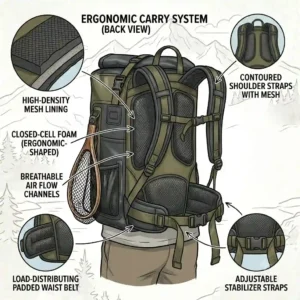
A bag holding 30 liters of water, tackle, and gear can easily weigh 25 pounds. A cheap bag uses flat nylon straps that will dig into your collarbones. Look for high-density EVA foam straps, a structural back panel that promotes airflow, and crucially, a padded hip belt to transfer the load from your shoulders to your hips.
Roll-Top vs. Submersible Zippers: The Real Difference
The battle between roll-top closures and submersible zippers is the most debated topic in outdoor gear. Let me break down the real-world implications of both.
The Submersible Zipper (Hydrolok/TRU Zip)
These zippers are engineering marvels, utilizing interlocking teeth embedded in thick rubber, or toothless extruded tracks.
The Advantage: Instant, binary security. When it’s zipped and docked, it is waterproof. You don’t have to guess. They also allow for wide, clamshell openings, giving you full visual access to your gear instantly.
The Disadvantage: They are expensive, stiff, and require routine maintenance. If a single tooth chips, the entire bag is compromised and essentially useless for submersion.
The Roll-Top Closure
This relies on folding the opening over itself at least three times and securing it with buckles, creating a tight mechanical seal.
The Advantage: Utter reliability. There are no moving parts to break, no teeth to jam with sand, and no lubrication required. They also naturally compress your load, keeping the bag tight against your back.
The Disadvantage: It is a slower process. When the fish are boiling and you need a new lure right now, unrolling and re-rolling the bag is incredibly frustrating. Additionally, if the bag is overstuffed and you can only manage two rolls, it is no longer waterproof.
Features That Actually Matter (And Those That Don’t)
After extensively testing gear in accordance with standards recognized by groups like the American Sportfishing Association, I’ve learned to instantly filter the marketing hype from the features that actually enhance your fishing experience.
What Actually Matters:
-
RF Welded Seams: Traditional stitching creates thousands of tiny holes in the fabric. Even if they are taped, they will eventually leak. High-frequency RF welding melts the TPU together, creating a continuous, molecularly bonded shell. Accept nothing less.
-
Light-Colored Interiors: A black interior absorbs light, making it impossible to find small items at dawn or dusk. Premium bags utilize high-visibility orange or bright green interior linings. This is a game-changer for visual contrast.
-
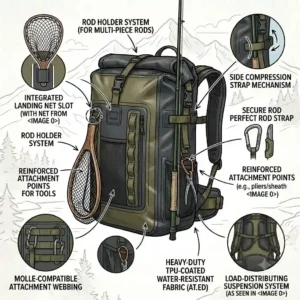
Rod Tube Attachments: If you hike to your spots, carrying a spare rod by hand is annoying. Look for strong, adjustable side compression straps paired with a deep side pocket to securely hold a spare rod tube.
What Doesn’t Matter:
-
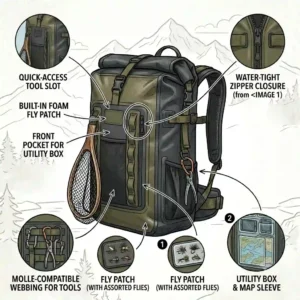
Excessive Daisy Chains: Brands love to cover bags in Molle webbing to look “tactical.” In reality, fishing involves loose monofilament and braided lines flying through the air. Every loop and buckle is a snag hazard. Sleek and minimal is better.
-
“Water-Resistant” Exterior Zippers: Many bags feature a waterproof main compartment but slap a cheap, splash-proof zipper on a front pocket. You will forget this distinction, put your phone in that front pocket, and ruin it when you wade too deep.
Common Mistakes When Buying Tackle Bags
Even experienced anglers make critical errors when transitioning from traditional canvas tackle boxes to waterproof backpacks. Here is my expert commentary on the pitfalls to avoid.
Mistake 1: Buying Too Much Capacity
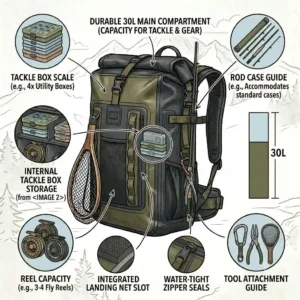
The golden rule of backpacking applies to fishing: you will always fill the space you have. If you buy a massive 40L bag, you will inevitably pack an extra three pounds of lead weights and five tackle trays you don’t need. This leads to crippling back pain. A 25L to 30L capacity is the absolute sweet spot for a full day on the water. It forces you to be deliberate and organized about what you carry.
Mistake 2: Confusing “Water-Resistant” with “Waterproof”
A water-resistant bag is treated with a DWR (Durable Water Repellent) coating. It beads up light rain, but if set down in a puddle on a boat deck, the water will eventually soak through the bottom fabric. A true waterproof fishing backpack is impermeable. Do not trust a DWR bag if you are carrying thousands of dollars in camera gear or electronic fish finders.
Mistake 3: Ignoring Structural Integrity
Many cheap dry bags are literally just floppy tubes of PVC with backpack straps glued on. When you take out a heavy tackle box, the bag collapses onto itself like a deflated balloon, making it infuriatingly difficult to put the box back in with one hand while holding your rod in the other. Always check if the bag has a semi-rigid structure or a molded base that allows it to stand upright unassisted.
Long-Term Cost & Maintenance
Let’s talk about the Total Cost of Ownership (TCO) and the “Efficiency Gap.” A common psychological hurdle is seeing a premium bag priced over $200 when a budget option sits at $50. But what is the true cost over a five-year period?
The budget $50 PVC bag, when exposed to harsh UV rays and salt, will typically stiffen and develop micro-cracks in the fold lines within two seasons. The cheap buckles become brittle and snap. Over five years, you will likely buy three of these bags, spending $150, and you will deal with the constant anxiety of whether this is the trip the seams finally give out and ruin your $800 smartphone.
Conversely, a premium TPU bag with RF-welded seams and a heavy-duty suspension system is a single, upfront capital expenditure. With the maintenance routine I outlined earlier (lubricating the zippers, avoiding interior mold), these bags easily last 7 to 10 years.
The ROI isn’t just in the longevity of the bag itself; it is the absolute peace of mind. When a sudden squall hits, you don’t scramble to hide your gear. You keep fishing. That uninterrupted focus on the water is the true value you are paying for.
✨ Don’t Miss These Exclusive Deals!
🔍 Ready to upgrade your tackle management? Click on any highlighted product above to explore current pricing. Stop letting wet gear ruin your weekend!
Conclusion: Final Thoughts on Securing Your Gear
Navigating the elements is half the battle in angling, and a high-quality waterproof fishing backpack is the ultimate equalizer. Whether you are battling the ocean spray on a slick jetty or hiking miles into the high country for native trout, trusting your gear allows you to focus entirely on the pursuit of the catch.
Remember, the spec sheet is just a starting point. Match the bag’s closure system and material density to your specific environment. If you wade deep, invest in a submersible zipper. If you fight the salt, stick to a rugged roll-top. Maintain your gear diligently, respect the elements, and your pack will serve as a reliable vault for years to come.
FAQs
❓ What is the difference between PVC and TPU waterproof bags?
✅ TPU (Thermoplastic Polyurethane) is lighter, more flexible in cold weather, environmentally safer, and vastly more durable against abrasion than PVC. PVC is cheaper and highly water-resistant but tends to become brittle and crack under long-term UV exposure and extreme cold…
❓ Can a waterproof fishing backpack be used as a floatation device?
✅ While an airtight bag trapping air will naturally float and can support its own weight in the water, it is absolutely not rated, certified, or safe to be used as a Coast Guard-approved personal flotation device (PFD) in an emergency…
❓ How do you clean a waterproof fishing backpack?
✅ Rinse the entire exterior with fresh, warm water after every saltwater use. Use a mild dish soap and a soft sponge to remove stubborn mud or fish slime. Never use harsh chemical solvents like bleach, as they will degrade the waterproof polyurethane laminations…
❓ Are submersible zippers really waterproof?
✅ Yes, high-quality submersible zippers (like the TRU Zip or Hydrolok) are 100% airtight and waterproof when fully closed and seated in their U-dock. However, a millimeter gap or a grain of sand in the teeth can compromise the entire seal…
❓ How much capacity do I need for a day of fishing?
✅ For a standard day trip, a 25L to 30L bag is optimal. This provides enough room for 2-3 standard 3600-size tackle trays, a lightweight rain jacket, lunch, water bottles, and essential safety gear without becoming excessively heavy or bulky…
Recommended for You
- Custom Dry Bags: 7 Best Personalized Waterproof Gear Options for 2026
- 7 Best july backpack Options for 2026: Expert Travel Gear Review!
- 7 Best Waterproof Fishing Backpack for 2026: Pro Angler’s Guide 🎣
Disclaimer: This article contains affiliate links. As an Amazon Associate, I earn from qualifying purchases. If you purchase products through these links, we may earn a small commission at no additional cost to you.
✨ Found this helpful? Share it with your friends! 💬🤗
