
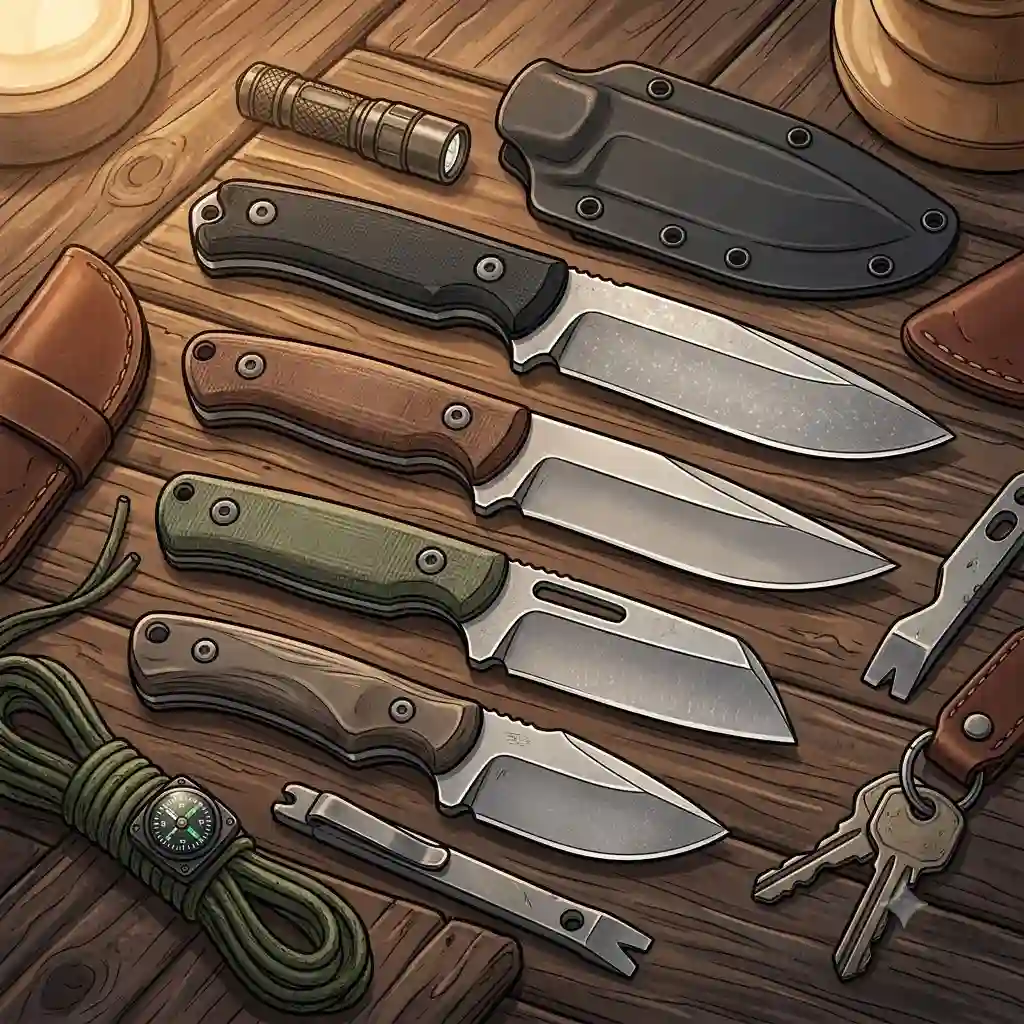
What is an EDC fixed blade knife? At its core, it is a non-folding knife designed specifically for everyday carry—compact enough to be concealed or carried comfortably, yet robust enough to handle daily cutting tasks without the mechanical weaknesses of a folding mechanism. For years, the pocket knife market was dominated by high-tech folders running on ceramic ball bearings. But over the last decade of my career consulting for tactical gear manufacturers and field-testing equipment, I’ve watched a massive shift back to basics.
People are realizing that moving parts eventually fail, especially when exposed to grit, lint, and hard use. When evaluating edc fixed blade knives, the primary advantage is undeniable: there is no pivot to snap, no lock bar to fail, and no deployment mechanism to jam. You draw the knife, and it is ready to work.
However, making the jump from a traditional folder to a fixed blade requires a mindset shift. It’s not just about the steel; it’s about the entire carry system. A fantastic blade paired with a terrible sheath will sit in a drawer gathering dust. In my field tests, I’ve found that the sheer utility of a perfectly dialed-in fixed blade completely changes how you approach daily tasks. Let’s dive into the models that actually deliver on their promises, backed by hundreds of hours of real-world use.
Quick Comparison: Top Daily Carry Fixed Blades
Before we break down the nuances of each knife, here is a high-level overview of how our top contenders stack up.
| Model | Blade Steel | Blade Length | Best For | Price Range |
| Bradford Guardian 3 | M390 / N690 | 3.5 inches | Premium all-around EDC | $120 – $160 |
| ESEE Izula-II | 1095 Carbon | 2.63 inches | Hard-use survival/utility | $70 – $90 |
| White River M1 Pro | CPM-S35VN | 3.0 inches | Ergonomic heavy cutting | $130 – $170 |
| CRKT Minimalist | 5Cr15MoV | 2.13 inches | Budget neck carry | $25 – $40 |
| Ka-Bar TDI | AUS-8A | 2.3 inches | Self-defense / Tactical | $40 – $60 |
Looking at the comparison above, the Bradford Guardian 3 delivers the best premium performance due to its ultra-edge-retaining M390 steel option, making it ideal for those who hate frequent sharpening. Budget buyers should note that the CRKT Minimalist sacrifices long-term edge retention for its highly accessible price point, while the ESEE Izula-II remains the undisputed king of hard-use durability, provided you are willing to maintain its rust-prone carbon steel.
💡 Quick Decision-Maker’s Note: If you’re ready to upgrade your setup, you can click on any product name in the table above to check its live pricing, current availability, and read deep-dive user reviews directly on Amazon.
[addtoany]
Top 5 edc fixed blade knives — Expert Field Analysis
1. Bradford Guardian 3
The Bradford Guardian 3 is widely considered the gold standard in this category, featuring a 3.5-inch blade crafted from either M390 or Böhler N690 steel. The M390 variant is a metallurgical marvel; this premium powder metallurgy steel means you can slice through heavy double-walled cardboard all day, and it will still cleanly slice a tomato for dinner. The knife comes standard with a horizontal cross-draw leather sheath. In practical terms, this means it sits parallel to your belt, completely disappearing under an untucked t-shirt without digging into your hip or car seat.
In my experience, what most buyers overlook about the Bradford Guardian 3 is the finger choil—the unsharpened notch behind the blade. If you have large hands, a 3.5-inch knife can feel cramped. But by choking up and placing your index finger in that choil, you gain the leverage and control of a much larger tool. It’s perfect for the urban professional or tradesman who needs serious cutting power but cannot carry a massive survival knife. The one downside I consistently notice is that the leather sheath, while beautiful, eventually stretches out after about a year of daily use, requiring a switch to an aftermarket Kydex option if you want zero-rattle retention.
Community feedback echoes these sentiments heavily. Most Amazon reviewers praise the out-of-the-box sharpness and the premium feel of the Micarta handle scales. At the $120 to $160 range, it represents a serious investment, but considering the high-end materials, the value proposition is incredibly strong for anyone who relies on their blade daily.
-
✅ Pros: Exceptional edge retention, highly concealable horizontal carry, outstanding ergonomics.
-
❌ Cons: Leather sheath loses retention over time, premium price tag.
2. ESEE Izula-II
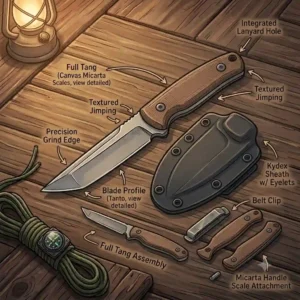
When you read the spec sheet for the ESEE Izula-II, you’ll see it boasts a 2.63-inch blade made of 1095 High Carbon Steel. Unlike stainless steels, 1095 is highly susceptible to rust, which scares away some beginners. However, what this spec translates to in the real world is absolute, unyielding toughness. You can pry, baton through kindling, and abuse this knife in ways that would shatter a harder stainless steel blade. The Izula-II upgrades the original Izula by adding a half-inch of handle length and full canvas Micarta scales, meaning you can finally get a full four-finger grip on it even while wearing heavy work gloves.
I typically recommend the ESEE Izula-II to landscapers, construction workers, and outdoor enthusiasts who view their knives as sharpened pry-bars. The spec sheet won’t tell you this, but the injection-molded polymer sheath is an absolute masterclass in simplicity. It clicks into place with authority and has never accidentally deployed during my field trials, whether I had it mounted on a backpack strap or scout-carried on my belt. You will need to oil the exposed edge regularly to prevent patina and rust, but that is a small price to pay for a knife backed by an unconditional lifetime warranty.
Scanning customer reviews, buyers are obsessed with the rugged reliability of this tool, frequently citing how it survives drops onto concrete and accidental trips through the washing machine. Sitting comfortably in the $70 to $90 range, it hits the sweet spot of affordability and professional-grade durability.
-
✅ Pros: Nearly indestructible steel, excellent four-finger grip, lifetime warranty.
-
❌ Cons: Carbon steel requires rust maintenance, thick blade geometry isn’t great for fine slicing.
3. White River M1 Backpacker Pro
The White River M1 Backpacker Pro brings a refined, almost surgical feel to the table. Featuring a 3.0-inch CPM-S35VN stainless steel blade, it strikes a near-perfect balance between edge retention, toughness, and corrosion resistance. S35VN was formulated specifically for high-end cutlery, meaning it resists chipping much better than older stainless steels. The handle is deeply contoured G10, locking your fingers into place effortlessly. Paired with its minimalist Kydex sheath, this knife is remarkably flat, making it virtually imperceptible in a front pocket or on a belt.
My hands-on assessment of the White River M1 Backpacker Pro places it firmly as the ultimate hybrid knife. If your weekends involve hunting or hiking, but your weekdays involve breaking down office boxes, this is your blade. The high flat grind makes it a slicing demon. However, the true standout feature is the Kydex sheath’s custom modularity. You can configure it for vertical, horizontal, or neck carry in minutes. What surprised me most during use was how the deep finger groove acts as an integrated hand guard, completely preventing your hand from sliding forward if you strike a hard object.
Reviews consistently highlight the impeccable fit and finish of this knife, often comparing it favorably to custom knives costing twice as much. In the $130 to $170 range, you are paying for premium American manufacturing and top-tier steel, but the ROI is immediate once you feel how seamlessly it integrates into your daily routine.
-
✅ Pros: Superb edge geometry for slicing, highly modular Kydex sheath, rust-resistant S35VN steel.
-
❌ Cons: Handle may be slightly thin for those with massive hands.
4. CRKT Minimalist Drop Point
Entering the budget category, the CRKT Minimalist Drop Point offers a 2.13-inch blade crafted from 5Cr15MoV steel. Let’s be clear: 5Cr15MoV is a softer, entry-level stainless steel. It will lose its razor edge much faster than S35VN or M390. However, the trade-off is that it takes literally seconds to resharpen on a ceramic rod. The true genius of this knife lies in its handle geometry. Designed by Alan Folts, the deeply grooved handle forces your first three fingers into a locked, ergonomic grip, while the included braided fob extends the handle just enough for your pinky to catch it.
I always hand the CRKT Minimalist to people who complain that fixed blades are “too heavy or bulky.” Weighing in at just 1.7 ounces, you will forget you are wearing it. The glass-reinforced nylon sheath is optimized for neck carry or attaching to a backpack strap. It is the perfect backup blade or primary EDC for office workers who want a low-profile package for opening mail or cutting zip ties. Because the steel is softer, I strictly advise against using it for heavy prying, as the tip will roll or snap under lateral stress.
The community consensus on this little blade is overwhelmingly positive, primarily because of the incredible ergonomics. Falling in the $25 to $40 range, it is an impulse buy that punches way above its weight class, serving as the perfect entry point for someone testing the waters of fixed blade carry.
-
✅ Pros: Unbeatable ergonomics for its size, incredibly lightweight, highly affordable.
-
❌ Cons: Edge dulls quickly, not suitable for heavy-duty prying.
5. Ka-Bar TDI Law Enforcement
The Ka-Bar TDI stands out immediately due to its radical, pistol-grip design. It features a 2.3-inch AUS-8A stainless steel blade set at a downward angle relative to the handle. AUS-8A is a tough, mid-range Japanese steel that takes an incredibly fine edge and resists rust adequately in humid environments. The unique angled geometry was designed specifically for close-quarters self-defense, allowing the user to draw and punch in a natural boxing motion without having to cock their wrist.
While marketed primarily toward law enforcement as an off-hand weapon retention tool, the Ka-Bar TDI has gained a massive civilian following. In my field tests, I found that the angled blade is actually fantastic for pulling cuts—like opening heavy soil bags or cutting through thick carpets. However, what most reviewers don’t mention is that the factory sheath clip sits quite high. If you carry this inside the waistband (IWB), the handle tends to stick up and print against your shirt. Upgrading to an aftermarket metal clip is almost mandatory to achieve a deep, concealed carry.
Customer reviews lean heavily into its rapid deployment and the secure, locked-in feeling of the angled Zytel handle. Ranging from $40 to $60, it provides a highly specialized tactical option that also functions reasonably well as a niche utility cutter.
-
✅ Pros: Highly intuitive draw mechanics, secure pistol grip, robust AUS-8A steel.
-
❌ Cons: Awkward for traditional cutting tasks (like food prep), factory clip rides too high.
🔍 Ready to Upgrade Your Carry Setup?
Transitioning to a fixed blade means maximizing reliability without the mechanical failures of traditional folders. Click on our recommended models above to view current pricing and find the perfect fit for your daily routine on Amazon.
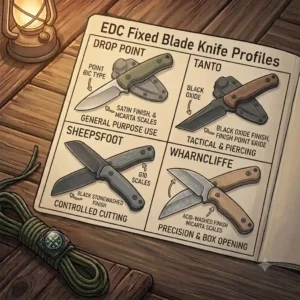
The Transformation: Practical Setup & Carry Guide
Buying the knife is only step one. How you integrate it into your wardrobe dictates whether it becomes an essential tool or a frustrating paperweight.
Step-by-Step Sheath Optimization
When your knife arrives, do not immediately strap it on. First, test the Kydex or polymer sheath retention. You should be able to hold the sheath upside down and shake it vigorously without the knife dislodging. If it feels loose, don’t return it immediately. Take a hairdryer or heat gun on a low setting, gently warm the area of the Kydex right around the trigger guard (or finger choil), and pinch it slightly to increase the friction fit.
Carry Positions Explained
-
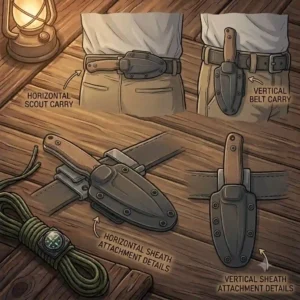
Scout Carry: Mounting the knife horizontally on the small of your back. This is incredibly comfortable when walking but can dig into your spine if you sit in a rigid chair or car seat for extended periods.
-
Appendix IWB: Carrying inside the waistband near the front pocket. This offers the fastest deployment and best concealment under a t-shirt, but requires a very slim sheath profile (like the White River M1).
-
Pocket Fixed Carry: Using an ulti-clip or a static cord attached to your belt loop to carry the knife deep in your front pocket. This is my personal favorite for urban environments, as drawing the knife looks exactly like pulling a pen from your pocket, minimizing unwanted attention.
Real-World Case Studies: Finding Your Match
It’s crucial to understand that a “perfect” knife can fail miserably if placed in the wrong environment. Let’s look at a few common user profiles.
The Urban Office Commuter
-
Profile: Wears slacks or jeans, works in a semi-professional environment, opens boxes, cuts zip-ties.
-
The Match: The CRKT Minimalist. Why? The anti-recommendation logic applies here. A heavy ESEE Izula-II is a terrible fit for this user; it will drag down dress pants and rust from body sweat if carried IWB. The Minimalist slips into a pocket unnoticed and handles light tasks perfectly.
The Tradesman / First Responder
-
Profile: Wears heavy work pants, deals with dirty environments, needs to cut heavy banding, rope, and occasionally pry staples.
-
The Match: The ESEE Izula-II. The thick carbon steel geometry won’t chip when interacting with dirt or wire, and the Micarta handles maintain grip even when soaked in oil or water.
The Weekend Adventurer
-
Profile: Hikes, camps, preps food on the trail, whittles wood.
-
The Match: The Bradford Guardian 3. The M390 steel will hold a shaving edge through an entire weekend of bushcraft and food prep, and the horizontal carry won’t interfere with the hip belt of a hiking backpack.
How to Choose edc fixed blade knives: An Expert Framework
To avoid buyer’s remorse, evaluate these three critical factors before pulling the trigger:
-
Blade Steel Metallurgy: Are you a “sharpen once a month” person or a “sharpen every night” person? If you hate maintenance, you must invest in premium steels like M390, S35VN, or MagnaCut. For a deep dive into how heat treatments affect steel hardness, the American Knife & Tool Institute (AKTI) offers excellent resources on knife steel properties.
-
Handle Material vs. Environment: G10 and Micarta are industry standards for a reason. G10 is essentially indestructible fiberglass, perfect for wet environments. Micarta (canvas or linen suspended in resin) absorbs a tiny bit of moisture, meaning it actually gets grippier when your hands are sweaty. Avoid smooth aluminum or bare skeletal tangs if you use your knife for prolonged, heavy cutting, as they will cause blistering.
-
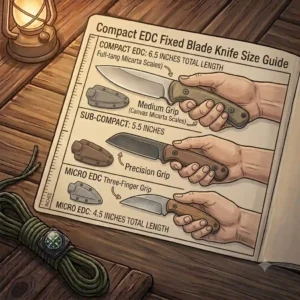
Overall Length Restrictions: In my experience, any fixed blade over 7.5 inches overall length becomes a chore to conceal daily. The sweet spot for an EDC fixed blade is between 5.5 and 7.0 inches overall, with a blade length hovering around 2.5 to 3.25 inches.
Common Mistakes When Buying Your First Fixed Blade
Most beginners make the exact same errors when transitioning away from folding knives.
Mistake 1: Ignoring the Sheath Quality
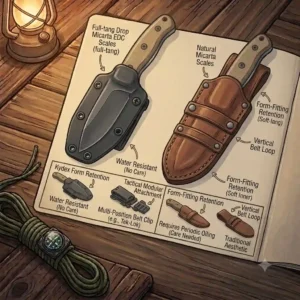
I cannot stress this enough: the sheath is 50% of the knife. A $300 custom blade in a terrible sheath is worthless. Many manufacturers cut costs by providing cheap, flimsy nylon sheaths. Always budget an extra $30-$50 for an aftermarket Kydex sheath if the factory option feels subpar.
Mistake 2: Buying Too Much Blade
Because fixed blades don’t fold, every inch of blade means an inch of handle and an inch of sheath. A 5-inch blade might look great online, but strapping an 11-inch piece of steel to your belt to go to the grocery store is absurd. Stick to blades under 3.5 inches for true daily carry.
Mistake 3: Fearing Carbon Steel
While S35VN is fantastic, don’t dismiss 1095 carbon steel just because it can rust. With a simple wipe-down using mineral oil once a week, carbon steel develops a beautiful, protective patina. It takes a wicked edge and is significantly easier to sharpen in the field than high-carbide stainless steels.
The Long-Term Maintenance Cycle (Year One Roadmap)
What happens to edc fixed blade knives after a year of hard use? Unlike a folding knife, you don’t have to disassemble it to clean out pocket lint, lube the pivot, or adjust the centering. The maintenance cycle is beautifully simple, but mandatory.
Months 1-3: You will notice Kydex sheaths starting to leave faint scratches on the blade finish. This is completely normal and unavoidable. If using a leather sheath, it will begin to mold to the exact shape of your body.
Months 6-9: Edge micro-chipping may occur if you use the knife on hard materials. This is when a leather strop loaded with diamond compound becomes your best friend. Stropping once a week prevents you from ever needing to do a full reprofile on a whetstone.
Month 12: Check your sheath hardware. The screws holding the belt clip to the Kydex can vibrate loose over time. Apply a single drop of blue thread locker to the screws to ensure they stay secure for the next year.
Fixed Blades vs. Folding Knives: The Final Verdict
When comparing fixed blades to traditional pocket folders, the analysis comes down to durability versus convenience.
A folding knife is undeniably more convenient. It fits completely inside a pocket, raises no eyebrows in an office environment, and requires no specialized belt or clip. However, every folding knife has a point of failure: the pivot. If you apply lateral pressure (twisting) to a folding knife, the lock will eventually buckle or the pivot will snap.
Fixed blades eliminate this entirely. The tang of the metal extends continuously through the handle. This means a 2.5-inch fixed blade can often handle heavier work than a 4-inch folding knife. You trade the convenience of pocket space for absolute, unwavering structural integrity. For those working in trades, law enforcement, or serious outdoor pursuits, that trade-off is a no-brainer.
Conclusion
Transitioning to a fixed blade for your daily carry is a commitment to reliability. By eliminating moving parts, you guarantee that your cutting tool will function precisely when you need it most, regardless of the mud, grit, or stress it endures. Whether you opt for the premium edge retention of the Bradford Guardian 3 or the indestructible, blue-collar toughness of the ESEE Izula-II, the key is finding a carry system that matches your wardrobe and lifestyle seamlessly. Remember, an EDC knife is only useful if it is actually on you. Dial in your sheath retention, practice your draw, and enjoy the peace of mind that comes with carrying a truly unbreakable tool.
FAQs
❓ What is the legal length for edc fixed blade knives?
✅ Knife laws vary drastically by jurisdiction. In many U.S. states, concealed fixed blades under 3 inches are legal, while others ban concealed fixed blades entirely regardless of length. Always verify your local municipal and state regulations before carrying…
❓ How do I stop my carbon steel knife from rusting?
✅ Apply a light coat of food-grade mineral oil or a specialized rust inhibitor like FrogLube to the blade weekly. Keep the knife dry, and avoid storing it long-term in a leather sheath, which can trap moisture…
❓ Is Kydex or leather better for an EDC sheath?
✅ Kydex is superior for secure, zero-maintenance retention and rapid deployment. Leather is more comfortable against the skin, conforms to your body over time, and looks less tactical, but it will eventually stretch and lose its tight grip…
❓ Can I carry a fixed blade in my pocket?
✅ Yes, using a method called “pocket fixed carry.” You attach a static line (paracord) from the sheath to your belt loop, or use a specialized pocket clip like an UltiClip mounted to the sheath, keeping the knife upright…
❓ How often should I sharpen my EDC knife?
✅ It depends on the steel and usage. Premium steels like M390 may only need sharpening every few months, while softer steels like 8Cr13MoV need weekly touch-ups. Regular stropping can drastically extend the time between full sharpening sessions…
Recommended for You
- 5 Top edc sling bag Choices for 2026: An Expert’s Brutally Honest Guide
- 5 Best tactical sling bag Models for 2026: Battle-Tested Expert Review
- Slim Pocket Knife Guide: 7 Best Lightweight Folders for 2026 EDC
Disclaimer: This article contains affiliate links. As an Amazon Associate, I earn from qualifying purchases. If you purchase products through these links, we may earn a small commission at no additional cost to you.
✨ Found this guide helpful? Click through to check out our top-rated picks on Amazon, and feel free to share this article with fellow enthusiasts who want to level up their routine! 💬🤗
[addtoany]
