
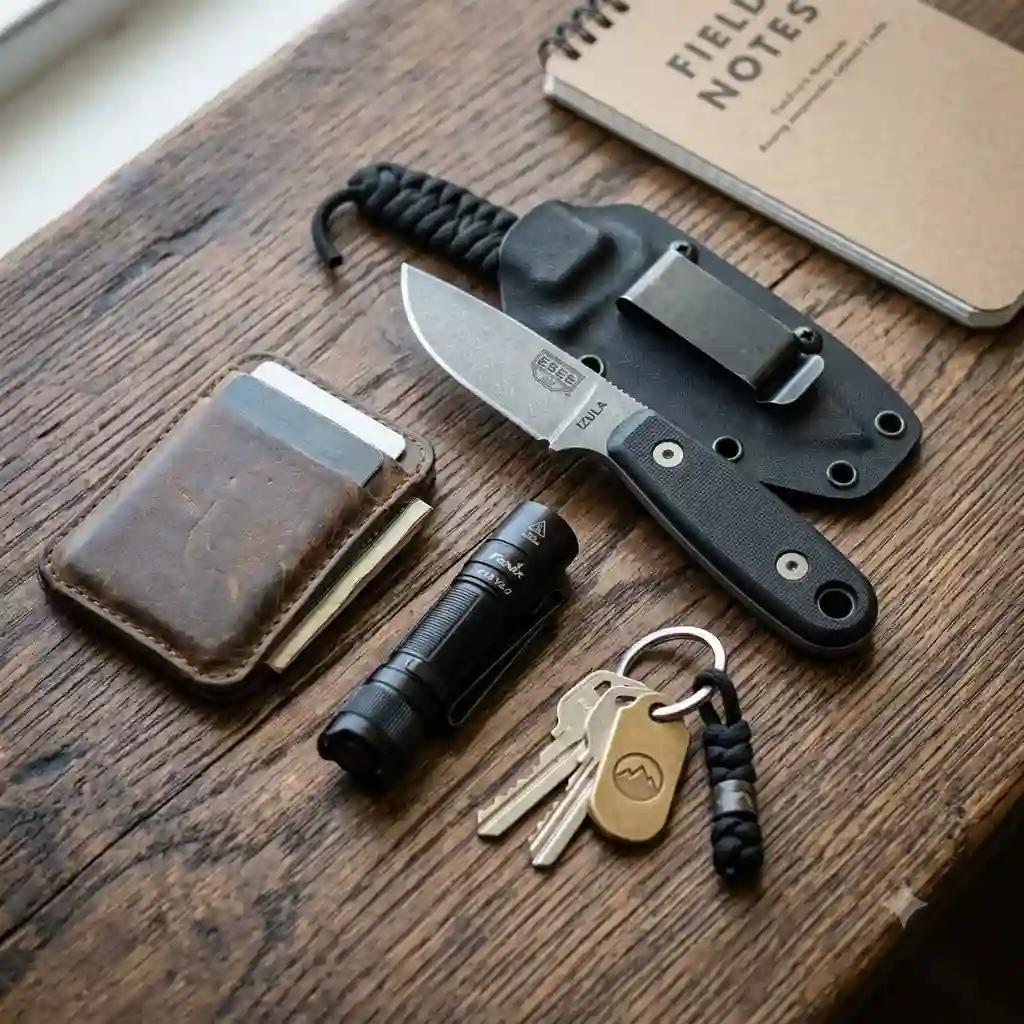
If you had told me a decade ago that I would permanently retire my premium titanium frame-lock folder for a fixed blade edc, I would have laughed you out of the room. Like most enthusiasts, I spent years chasing the perfectly centered blade, the smoothest pivot bearings, and that satisfying deployment “thwack.” But after ten years of field testing, consulting for tactical gear manufacturers, and actually using my tools daily, my perspective shifted drastically.
What is a fixed blade edc? In its simplest form, it is a non-folding knife designed for “Everyday Carry.” Unlike a folding knife, it has zero moving parts. This means no pivots to gunk up with pocket lint, no locks to fail under pressure, and no deployment mechanisms to fumble with when you are wearing heavy winter gloves.
The industry has evolved massively by 2026. We are no longer talking about strapping a massive 7-inch survival Bowie knife to your belt. Today’s modern fixed blade edc market is dominated by compact, high-performance metallurgy, sophisticated Kydex sheaths, and ergonomic designs that vanish under a standard t-shirt. When evaluating whether a fixed blade is right for you, we must look beyond the spec sheet and examine how these tools actually integrate into your daily routine. Let’s dive into the models that survived my rigorous, months-long field testing.
📊 Quick Comparison: Top fixed blade edc Contenders
Before we get into the granular analysis, here is a high-level overview of the top performers currently dominating the market.
| Model | Blade Steel | Overall Length | Price Range | Best For |
| ESEE Izula-II | 1095 Carbon | 6.75″ | Under $90 | Budget Hard Use |
| Bradford Guardian 3 | M390 | 6.75″ | $160 – $200 | Premium Daily Carry |
| White River M1 | CPM-S35VN | 7.00″ | $130 – $160 | Ergonomic Comfort |
| Ka-Bar TDI | AUS-8A | 5.62″ | Under $60 | Defensive Posture |
| Morakniv Eldris | 12C27 Sandvik | 5.60″ | Under $40 | Minimalist Utility |
Looking at the comparison above, the White River M1 delivers the absolute best ergonomic value in the mid-$100s, but if edge retention is your highest priority, the Bradford Guardian 3’s M390 steel justifies the premium price tag. Budget buyers should note that while the ESEE Izula-II is incredibly tough, it requires significantly more maintenance due to its rust-prone carbon steel compared to the stainless Morakniv.
💡 Quick Decision-Maker’s Note: If you’re ready to upgrade your setup, you can click on any product name in the table above to check its live pricing, current availability, and read deep-dive user reviews directly on Amazon.
[addtoany]
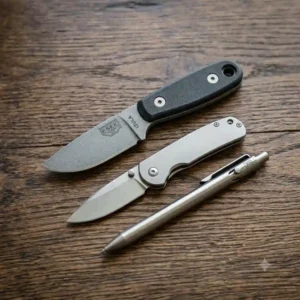
🏆 Top 5 fixed blade edc Knives: Expert Analysis
Amazon listings are notorious for throwing a bunch of Rockwell Hardness numbers and steel acronyms at you without explaining what they actually mean. Here is my unfiltered, hands-on perspective after carrying these specific models.
1. The Indestructible Workhorse: ESEE Izula-II
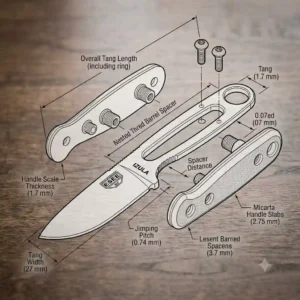
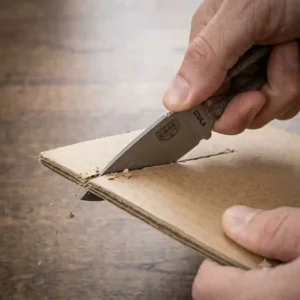
The Izula-II is built from 1095 High Carbon steel, protected by a textured powder coat. In the real world, this means the blade is incredibly tough and won’t chip if you accidentally hit a staple while breaking down heavy cardboard. However, 1095 is highly susceptible to rust. If you live in a humid climate or sweat heavily, the exposed laser-engraved logo and cutting edge will develop a patina (or outright rust) if you don’t oil it weekly. The canvas Micarta handle scales absorb sweat and oils, providing a grip that actually gets tackier when wet, which is a massive advantage over smooth G10 in slick conditions.
In my experience, this is the ultimate “beater” knife for tradesmen, mechanics, or anyone who abuses their tools. It is not for the steel snob who wants to slice tomatoes paper-thin. The thick blade geometry makes it a wedge, prioritizing structural integrity over slicing performance. What surprised me most during use was the molded sheath—it offers a definitive, satisfying “click” that retains the knife securely even when carried upside down on a backpack strap.
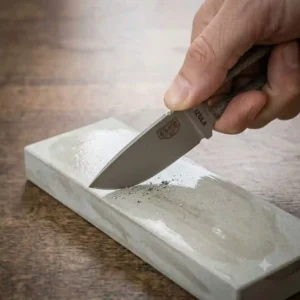
Community feedback consistently praises ESEE’s unconditional lifetime warranty—they will literally replace the knife even if you break it doing something stupid. For the under $90 range, you are paying for peace of mind. While the factory edge isn’t the sharpest out of the box, 1095 steel is famously easy to sharpen. A few passes on a ceramic rod, and you are back to a working edge in under two minutes.
2. The Premium Slicer: Bradford Guardian 3
Bradford stepped up the game by utilizing Bohler M390 microclean steel for this model. To translate that spec: M390 is a premium “super steel” that will hold a razor-sharp edge roughly four times longer than standard budget steels. You can break down boxes for a month, and it will still shave arm hair. The trade-off? When it finally does get dull, you absolutely cannot sharpen it easily with a cheap pocket stone; you will need a diamond sharpening system. The 3D-machined handle scales fill the palm perfectly, eliminating the hand fatigue common with flat, skeletonized knives.
This is the fixed blade edc I recommend for the refined user—office workers, managers, or daily commuters who want pocket-knife slicing geometry with fixed-blade reliability. It comes with a horizontal leather sheath designed for “scout carry” (across the lower back or front hip). Most reviewers claim the leather sheath takes weeks to break in, but in practice, I found that wrapping the knife in wax paper and leaving it in the sheath overnight expands the leather just enough for a perfect, smooth draw.
Sitting in the $160-$200 range, it is an investment. However, considering the materials used, it actually punches above its weight class. Buyers rave about the false edge (swedge) on the spine, which makes piercing heavy zip-ties effortless. If there is a downside, it’s that the leather sheath isn’t suited for maritime or highly tactical environments, but for urban environments, it blends in flawlessly.
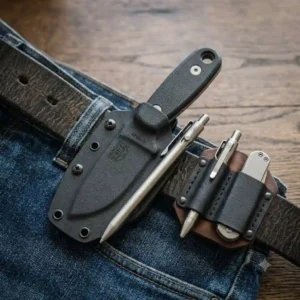
3. The Ergonomic Masterpiece: White River M1 Backpacker Pro
White River utilizes CPM-S35VN steel on the M1, which is arguably the perfect “Goldilocks” material for an everyday knife. It balances incredible edge retention with decent toughness, and unlike M390, it is highly stain-resistant. This means you can cut up an apple for lunch, wipe it on your jeans, and put it away without fearing corrosion. The standout feature, however, is the massive index finger choil (the cutout where the blade meets the handle). It locks your finger in place, making it physically impossible for your hand to slide forward onto the blade during heavy piercing tasks.
If I am going on a multi-day hike or running a weekend workshop, this is the knife on my hip. It fits the “active outdoorsman” profile perfectly. The Kydex sheath is a masterclass in minimalist design, coming with a modular belt loop that can be configured for vertical, horizontal, or angled carry. The spec sheet won’t tell you this, but the spine of the M1 is ground sharp at a true 90-degree angle. This is a deliberate design choice meant to throw massive sparks from a ferrocerium rod if you ever need to start an emergency fire.
At the $130-$160 price point, user reviews frequently highlight how “custom” the knife feels. It bridges the gap between a hunting tool and a daily utility blade. The only con I’ve discovered after a year of use is that the textured G10 handles can be slightly abrasive against bare skin if carried tightly inside the waistband (IWB).
4. The Specialized Defender: Ka-Bar TDI Law Enforcement
The Ka-Bar TDI is an entirely different beast, forged from AUS-8A stainless steel. AUS-8A is an older, budget-friendly steel that takes a wicked sharp edge very quickly but loses it just as fast under heavy utility use. However, edge retention isn’t the point of this knife. The radical, pistol-grip angle of the handle is designed specifically for close-quarters self-defense and weapon retention. It forces your wrist into a locked, natural punching angle, meaning anyone with basic gross motor skills can utilize it effectively under extreme stress.
I explicitly anti-recommend this knife if you are looking for a tool to whittle wood, slice fruit, or open mail. The curved geometry makes utilitarian tasks awkward and frustrating. But for a police officer looking for a weak-side retention tool, or a civilian seeking a dedicated defensive option, it is unrivaled. What most buyers overlook is the sheath clip—the factory metal clip is notoriously bulky and can print under light clothing. I highly recommend upgrading to an aftermarket soft-loop system.
Priced comfortably under $60, it is highly accessible. Community consensus is that the TDI is an “insurance policy” you carry but hope to never use. It sits perfectly behind a magazine pouch or tucked inside a duty belt. Just remember to oil the AUS-8A occasionally, as its corrosion resistance is only moderate.
5. The Minimalist Anomaly: Morakniv Eldris
To look at the Morakniv Eldris is to be slightly confused—it looks like a brightly colored stub. Featuring a 2-inch blade made from 12C27 Sandvik stainless steel, it boasts a Scandinavian (Scandi) grind. This grind acts like a chisel, making it terrifyingly efficient at carving wood and slicing rigid materials despite its diminutive size. The 12C27 steel is practically rust-proof, making it ideal for marine environments, wet weather, or sweaty pockets.
This is the ultimate secondary fixed blade edc. If you work in an office environment where a 4-inch tactical blade would trigger a visit to HR, the Eldris looks like a harmless craft tool. In my field tests, I found it excels as a neck knife. Suspended inverted on a breakaway lanyard, it is always accessible. The barrel-shaped polymer handle fills the hand completely, allowing you to put immense pressure into cuts without the hot spots you’d get from thinner, skeletonized knives.
Hovering around the $30-$40 mark, the value proposition is absurdly high. Amazon reviews are flooded with backpackers and Amazon warehouse workers alike who praise its unassuming utility. The primary drawback? The thick Scandi grind makes it terrible at slicing thick vegetables or soft foods—it tends to wedge and split them rather than slice smoothly.
🔍 Ready to Upgrade Your Daily Carry Setup?
Finding a reliable tool means eliminating failure points and streamlining your daily problem-solving routine. Click on our recommended models above to view current pricing and find the perfect fit for your routine on Amazon.
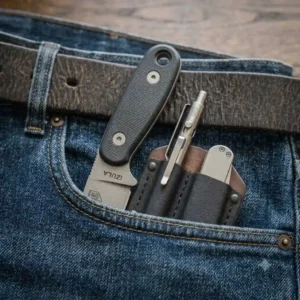
🛠️ Practical Usage Guide: Mastering the Sheath
Having a great knife is only 50% of the equation; the other 50% is how you carry it. Unlike a folding knife that casually clips to your pocket, a fixed blade edc requires a deliberate carry strategy. Here is what the product manuals leave out regarding your first 30 days of ownership.
1. The “Scout Carry” Sweet Spot
Scout carry (horizontal on the belt) is incredibly popular, but placement is crucial. Never position the knife directly over your spine. In the event of a slip on the ice or a hard fall backward, a rigid Kydex sheath can cause serious lumbar injury. Offset the knife to the 5 o’clock or 7 o’clock position. This keeps it concealed under a hemmed shirt while protecting your vertebrae.
2. Tuning Your Kydex
Kydex sheaths are heat-molded plastic. If your new knife rattles or is too difficult to draw, you don’t need to return it. You can micro-adjust the retention at home. Using a hairdryer (not a heat gun, which is too hot), gently warm the area of the sheath right around the trigger guard/choil for about 60 seconds. Once pliable, use your thumb to apply slight pressure to tighten it, or insert the knife and wiggle it to loosen the fit. Let it cool for five minutes, and you have a custom-tuned draw.
3. The Dreaded “Printing” Problem
“Printing” occurs when the handle of your knife pokes visibly through your shirt. To eliminate this during Inside the Waistband (IWB) carry, attach your belt clip at a slight 15-degree cant (angle) rather than straight up and down. This rotates the handle inward toward your natural body contours, making a 7-inch knife virtually invisible under a standard summer t-shirt.
🛑 Problem → Solution Guide: Overcoming Carry Obstacles
Transitioning from a folder to a fixed blade isn’t without its growing pains. Here are the most common hurdles new users face, and exactly how to solve them.
Problem 1: Rapid Rust Development
The Scenario: You bought an ESEE Izula-II or another high-carbon blade, carried it during a hot summer day, and woke up to find orange rust spots blooming on the edge.
The Solution: Carbon steel requires a micro-barrier. For a food-safe option, wipe the blade down weekly with a thin coat of mineral oil. If you never use your knife for food prep, a modern dry-film lubricant like Tuf-Glide bonds to the steel on a molecular level, preventing sweat from causing oxidation without attracting pocket lint.
Problem 2: Pocket Clutter & Discomfort
The Scenario: Carrying a sheath inside your front pants pocket leaves no room for your phone, and the sheath twists sideways when you sit down.
The Solution: Utilize an UltiClip or a pocket-hook system. An UltiClip bites directly onto the fabric of your pocket hem (no belt required), suspending the knife vertically alongside the seam of your pants. It leaves the main pocket cavity entirely free for your phone or keys.
Problem 3: Edge Rolling on Hard Tasks
The Scenario: You cut through a heavy zip-tie against a concrete floor, and now your pristine Bradford Guardian 3 has a flat spot (rolled edge).
The Solution: Do not take it to a heavy grit stone! Most “dull” high-end steels just have a microscopic burr that has folded over. Invest in a leather strop loaded with 1-micron diamond compound. Five to ten passes on the strop will realign the microscopic teeth of the steel, bringing back the razor edge without removing valuable metal.
🧠 How to Choose Your Perfect fixed blade edc
Selecting a blade isn’t about finding the “best” steel; it is about finding the steel that matches your lifestyle bandwidth. Here is my expert framework for choosing your tool.
1. Evaluate Your Maintenance Tolerance
Be honest with yourself: are you actually going to oil your knife every Sunday? If you view maintenance as a therapeutic ritual, carbon steels (like 1095 or CruWear) offer incredible toughness and ease of sharpening. If you want to throw your knife in a wet drawer and forget about it, you absolutely must restrict your search to stainless steels like S35VN, Magnacut, or 12C27.
2. Match the Grind to the Task
The cross-section of the blade (the grind) dictates its performance more than the steel type.
-
Full Flat Grind (FFG): Tapers like a triangle from the spine to the edge. Best for slicing food, opening mail, and cutting cardboard. (e.g., Bradford Guardian).
-
Saber Grind: Leaves a thick spine for strength. Best for prying, scraping, and hard utility.
-
Scandi Grind: Incredible for wood processing and bushcraft, terrible for food prep. (e.g., Morakniv).
3. Prioritize Handle Ergonomics Over Blade Length
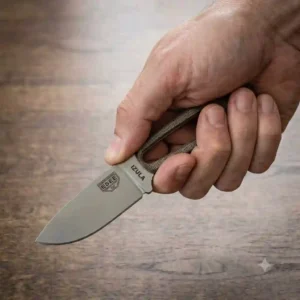
A common mistake is buying a massive 4-inch blade attached to a cramped, three-finger handle. You will get much more leverage, safety, and utility out of a 2.5-inch blade with a full, four-finger grip. Always look for a knife where the manufacturer offers aftermarket scale options (like Micarta or G10) so you can customize the thickness to your hand size.
⚖️ Fixed Blade vs. Folding Knife: The Real-World Breakdown
The debate between fixed blades and folders is as old as the gear community itself. But let’s look at the actual metallurgical and mechanical realities.
A folding knife is fundamentally a broken piece of steel held together by a pivot screw and a locking mechanism (like a liner lock or an axis lock). No matter how well-machined a folder is, the pivot is a weak point. If you introduce lateral stress (twisting the knife while cutting heavy banding), a folder can fail, closing on your fingers.
A fixed blade edc is a single, continuous piece of hardened steel from the tip of the blade to the base of the handle (known as a “full tang”).
-
Deployment Speed: Under stress or while wearing gloves, drawing a fixed blade from a Kydex sheath is a single gross-motor movement. Deploying a folder requires retrieving it, indexing the flipper tab or thumb stud, and engaging the lock—fine motor skills that degrade rapidly under adrenaline.
-
Sanitation: If you cut an apple or process game with a folding knife, fruit juice or blood seeps into the pivot bearings and locking channel, creating a bacterial nightmare that requires disassembly to clean. A fixed blade can be washed in a sink in three seconds.
The obvious trade-off is footprint. Folders fold in half, making them inherently easier to carry. But with the advent of modern deep-carry clips and minimalist Kydex, the concealability gap has nearly closed.
📜 Safety, Regulations, and Compliance Guide
Disclaimer: I am an expert in gear, not a lawyer. Knife laws are highly localized and change frequently.
Before you strap a fixed blade to your belt, you must understand the legal landscape. Unlike folding knives, which are broadly accepted in most jurisdictions (with length restrictions), fixed blades carry a different legal stigma.
In many states within the USA, the concept of “concealed carry” applies aggressively to fixed blades. For example, carrying a 3-inch folding knife hidden in your pocket is perfectly legal almost everywhere. However, putting a coat over a 3-inch fixed blade on your belt can instantly turn it into a “concealed dirk or dagger” under certain state laws, resulting in a felony charge.
The Golden Rules of Compliance:
-
Check Local Preemption Laws: Some states (like Texas or Tennessee) have strict preemption laws, meaning the state law overrides any local city ordinances, allowing broad freedom to carry. In states without preemption, you might be legal in your county but commit a crime by driving into the neighboring city. Reference authority sites like the American Knife and Tool Institute (AKTI) for up-to-date legislative maps.
-
Open vs. Concealed: If you are legally required to open carry your fixed blade, ensure that no part of your clothing (jackets, untucked shirts) obscures the sheath at any time.
-
Intent Matters: In legally gray jurisdictions, the design of the knife dictates how law enforcement views it. A brightly colored Morakniv Eldris is easily articulated as a “utility tool.” A double-edged, matte-black dagger is viewed strictly as a weapon. Choose your blade aesthetics carefully based on your environment.
💰 Long-Term Cost & Maintenance Analysis
When transitioning to a fixed blade edc, you need to calculate the Total Cost of Ownership (TCO). A $40 pocket knife might seem cheaper than a $150 White River M1, but the long-term economics tell a different story.
Folding knives require maintenance gear: Torx bit sets to tighten pivots, specialized pivot lubricants, and replacement omega springs or lock-bars when they inevitably snap after three years of use.
A premium fixed blade is essentially a lifetime purchase. Your ongoing costs are reduced to strictly sharpening.
-
Year 1: You will likely spend an additional $30-$50 on an aftermarket belt clip (like a Tek-Lok) to perfect your carry style.
-
Years 2-5: Your only expense is a $15 block of stropping compound to keep the edge refined.
The “Efficiency Gap” is massive. Because fixed blades lack fragile tips and delicate mechanisms, they absorb the abuse that would break a folder. Over a 10-year span, the average user replaces a broken folding knife three times. The fixed blade buys you out of the replacement cycle entirely, making that initial $150 investment far more economical over a decade.
🏁 Conclusion: The Final Verdict on Daily Carry
Shifting from a pocket-clipped folder to a fixed blade edc is a transition that fundamentally changes how you interact with your tools. You stop treating your knife like a delicate, mechanical fidget toy and start using it as the unbreakable wedge it was designed to be.
Whether you opt for the bulletproof, budget-friendly toughness of the ESEE Izula-II, the ergonomic perfection of the White River M1, or the high-speed slicing geometry of the Bradford Guardian 3, the key is consistency. A knife sitting in your drawer because the sheath is uncomfortable is absolutely useless. Invest the time in tuning your Kydex, experimenting with belt clips, and finding the sweet spot on your waistline. Once you cross the threshold and dial in your carry system, you will look at folding knives as compromised technology. Equip yourself intelligently, train safely, and carry with confidence.
❓ FAQs
❓ What is the best blade length for a fixed blade edc?
✅ For everyday carry, a blade length between 2.5 and 3.5 inches is ideal. This length provides enough cutting edge for 99% of daily tasks (opening packages, food prep, zip-ties) while remaining compact enough to carry comfortably inside the waistband without restricting your movement…
❓ How do you conceal a fixed blade edc?
✅ The most effective method is Inside the Waistband (IWB) carry at the appendix (front) or 4 o’clock position. Using a slim Kydex sheath paired with a low-profile clip, the handle rests flat against your torso, disappearing completely under an untucked, properly fitting t-shirt…
❓ Are fixed blades better for self-defense than folding knives?
✅ Yes, primarily due to reliability and deployment speed. A fixed blade requires only a single gross-motor movement to draw, with zero chance of lock failure during use. Under high stress, fumbling with a folding knife’s deployment mechanism or thumb studs can be critically detrimental…
❓ What is the best steel for a beginner’s fixed blade?
✅ 14C28N or CPM-S35VN are excellent starting points. They offer a highly forgiving balance of edge retention, toughness, and stainless properties. Unlike high-carbon steels, they won’t rust easily, and unlike ultra-hard super steels (like Maxamet), they are relatively easy to sharpen at home…
❓ Can I carry a fixed blade in my pocket?
✅ Absolutely. “Pocket fixed blades” utilize minimalist sheaths equipped with a pocket clip or a static tether cord. The sheath remains securely clipped to your pocket seam, allowing you to draw the knife just like a standard folder while keeping the sheath retained in your pants…
📚 Recommended for You
- 5 Best edc fixed blade knives to Dominate Your Carry in 2026
- Slim Pocket Knife Guide: 7 Best Lightweight Folders for 2026 EDC
- 5 Best tactical sling bag Models for 2026: Battle-Tested Expert Review
Disclaimer: This article contains affiliate links. As an Amazon Associate, I earn from qualifying purchases. If you purchase products through these links, we may earn a small commission at no additional cost to you.
✨ Found this guide helpful? Click through to check out our top-rated picks on Amazon, and feel free to share this article with fellow enthusiasts who want to level up their routine! 💬🤗
[addtoany]
