

If you have ever spent an hour rummaging through a cavernous, unorganized bag for your keys or felt the burning ache of thin straps digging into your shoulders during a subway commute, you know that not all bags are created equal. In my ten years testing, designing, and consulting on soft-goods and tactical gear, I’ve realized that finding the right bag is less about holding your items and more about streamlining your life.
So, what is an everyday carry backpack? In essence, an everyday carry backpack (often abbreviated as EDC) is a purpose-built, mid-capacity bag—typically between 15 and 26 liters—designed to seamlessly transport your essential daily items from home, to work, to the gym, and back. Unlike a rugged hiking pack or a flimsy school bookbag, a true EDC pack balances weather resistance, ergonomic suspension, and meticulous internal organization. It must protect a $2,000 laptop just as well as it isolates a damp gym shirt.
Most manufacturers promise the world, claiming their bags are revolutionary. However, in practice, a bag’s true worth is proven at 7:00 AM on a rainy Tuesday when you are rushing to catch a train. In this guide, I am going to tear down the marketing hype. I will share the subtle engineering details, the hidden ergonomic flaws, and the long-term durability realities of the market’s top performers for 2026. Let’s find a pack that works as hard as you do.
Quick Comparison Table: Top Picks at a Glance
| Bag Model | Best For | Key Material | Laptop Fit | Price Range |
| Aer City Pack Pro | The Urban Professional | 1680D Ballistic Nylon | Up to 16″ | Mid-$200s |
| GORUCK GR1 (21L) | Buy-It-For-Life Durability | 1000D Cordura | Up to 16″ | $300+ Premium |
| Peak Design V2 20L | Photographers & Creatives | 400D Weatherproof Canvas | Up to 15″ | High $200s |
| The North Face Recon | Active Budget Commuters | 210D Recycled Nylon | Up to 15″ | Under $150 |
| Bellroy Transit Workpack | Minimalist Office Workers | Recycled Baida Nylon | Up to 16″ | Around $200 |
Looking at the comparison above, the Aer model strikes the best balance of tech organization and sleek office aesthetics in the mid-$200s. However, if extreme durability is your priority and you don’t mind a break-in period, the GORUCK’s military-grade construction easily justifies its premium price point. Budget-conscious buyers should lean toward The North Face, which sacrifices some high-end hardware but delivers exceptional comfort and capacity for a fraction of the cost.
💬 Just one click — help others make better buying decisions too! 😊
[addtoany]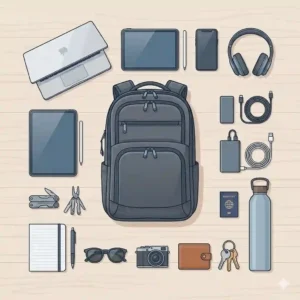
Top 5 Everyday Carry Backpacks: Expert Analysis
1. Aer City Pack Pro: The Best All-Around Commuter
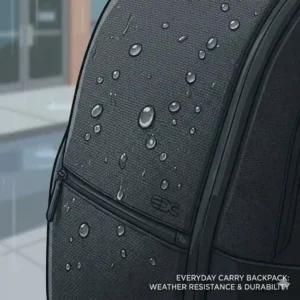
The Aer City Pack Pro features a stunningly efficient clamshell opening that transforms packing from a chore into a seamless ritual. Built with an exterior of 1680D Cordura ballistic nylon and YKK AquaGuard zippers, this isn’t just a spec sheet flex; practically, this means you can set the bag down in a wet coffee shop puddle or walk through a heavy spring downpour without a drop of water reaching your electronics. The suspended laptop sleeve actually hovers about an inch above the bottom of the bag, saving your device from catastrophic corner-drops.
In my field tests, I found this bag to be the absolute sweet spot for the modern hybrid worker. The tech organization panel doesn’t steal main compartment volume like it does on older Aer models. Most reviewers rave about the aesthetics, but in practice, I found the contoured EVA foam back panel to be the real hero, preventing the dreaded “sweaty back” syndrome during summer commutes. Customers consistently highlight the bag’s ability to stand upright on its own, a massively underrated feature when sitting at a desk.
-
Pros: Stands up on its own, incredible tech organization, weather-resistant zippers.
-
Cons: Can look slightly boxy on smaller frames, top quick-access pocket eats into main volume.
-
Price Range: Mid-$200s — Exceptional value for premium materials and daily utility.
2. GORUCK GR1 (21L): The Unbreakable Heirloom
The GORUCK GR1 is famous for its bombproof construction and a fully flat-opening main compartment. Crafted from heavily abrasive 1000D Cordura nylon with a bomb-proof laptop compartment reinforced by a hard plastic frame sheet. What this means in the real world is that this bag will outlive you. You can drag it across concrete, over-stuff it with weights, and drop it out of a truck, and the stitching will not pop. The laptop sleeve sits against your back, completely isolating the tech from whatever chaotic gear you throw in the main cavity.
I recommend this bag primarily for individuals who are tough on their gear—frequent travelers, first responders, or those who want a true “buy-it-for-life” item. What the spec sheet won’t tell you is that 1000D Cordura is incredibly stiff out of the box. You will spend the first three weeks breaking in the shoulder straps, but once they mold to your shoulders, it becomes the most comfortable heavy-load bag you own. Feedback from long-term owners always centers on its indestructible nature, though some lament the lack of internal water bottle pockets.
-
Pros: Literally indestructible, lifetime SCARS warranty, excellent heavy load dispersion.
-
Cons: Extremely abrasive on softer clothing (like merino wool), very limited built-in organization.
-
Price Range: $300+ range — A high upfront cost that pays for itself over decades of abuse.

3. Peak Design Everyday Backpack V2 20L: The Creator’s Dream
The Peak Design Everyday Backpack V2 utilizes a proprietary MagLatch closure system paired with dual side-access zippers. Constructed from a 400D double poly-coated DWR-impregnated canvas, its shell provides excellent weather resistance while remaining incredibly lightweight. The real magic is the internal FlexFold dividers; they act as origami-like shelves that you can snap and fold into various shapes, allowing you to instantly compartmentalize a camera, a drone, and your lunch without any of them touching.
If you are a photographer, content creator, or someone who carries varying, fragile equipment daily, this is the pinnacle of design. In my experience, what most buyers overlook is the genius of the side-access panels. You can sling the bag over one shoulder and access your camera in three seconds without taking the bag off. However, for a standard office worker just carrying a laptop and some notebooks, the rigid structure feels over-engineered and stiff. Users love the aesthetic but often note the straps lack heavy padding for long-haul hikes.
-
Pros: Best-in-class side access, customizable interior, brilliant magnetic hardware.
-
Cons: Stiff shoulder straps, over-complicated for non-creators.
-
Price Range: High $200s — An investment piece specifically tailored for hardware-heavy creatives.
4. The North Face Recon: The Best Budget Multi-Tasker
The North Face Recon features their updated FlexVent suspension system and a highly versatile front stretch-mesh stash pocket. Utilizing a lighter 210D recycled nylon ripstop, it sheds weight while offering plenty of organization, including a dedicated, highly protective laptop compartment. The practical translation of the “FlexVent” system is that the shoulder straps are injection-molded, giving them a springy, forgiving feel that excels when you’re running to catch a bus or biking across campus.
I point budget-conscious buyers, college students, and gym-goers to the The North Face Recon constantly. Why? Because it spans the gap between the boardroom and the hiking trail better than anything else under $150. The front mesh pocket is a godsend for quickly stashing a wet rain jacket or sweaty gym clothes away from your electronics. While long-term users praise its comfort, some mention that the softer nylon construction means it slumps over when empty, lacking the structured stance of premium bags.
-
Pros: Incredible suspension comfort, versatile exterior storage, excellent price-to-performance ratio.
-
Cons: Does not stand up on its own, looks more “outdoorsy” than professional.
-
Price Range: Under $150 — The ultimate value pick for students and active commuters.
5. Bellroy Transit Workpack: The Minimalist Office Companion
The Bellroy Transit Workpack boasts a remarkably clean exterior profile hiding a surprisingly cavernous 20L interior. Made from their custom water-resistant woven fabric (derived from recycled materials), it features hidden side pockets designed specifically to swallow a water bottle without ruining the bag’s sleek silhouette. The laptop section is heavily padded and features a water-resistant zip, meaning your tech is safe from both drops and sudden spills.
This is the quintessential bag for the modern, design-conscious professional who transitions from a corporate office to an upscale gym. In my field testing, I was blown away by the organization; it’s intuitive without being prescriptive. You aren’t forced to use tiny, specific slots. Instead, you get stretchy, forgiving mesh pockets. The anti-recommendation here: if you carry bulky, oddly shaped gear, the Bellroy Transit Workpack‘s tapered design will frustrate you. Users consistently praise its professional look but note the zippers can be stiff around the corners.
-
Pros: Beautiful minimalist aesthetic, hidden water bottle pockets, premium interior feel.
-
Cons: Zippers catch on the corners, tapered bottom limits bulky item storage.
-
Price Range: Around $200 — A sophisticated option for those prioritizing office aesthetics.
✨ Don’t Miss These Exclusive Deals!
🔍 Take your daily commute to the next level with these carefully selected products. Click on any highlighted item to check current pricing and availability. These tools will help you create authentic carrying solutions your back will love!
Real-World Scenarios: Matching Your Profile to the Right Pack
The biggest mistake I see clients make is buying a bag for the life they wish they had, rather than the life they actually live. A perfect everyday carry backpack for a freelancer will actively annoy a corporate lawyer. Let’s break down three common case studies to find your exact match.
Scenario 1: The Multi-Modal Commuter (Subway + Walking + Coffee Shop)
You carry a 14-inch MacBook, an iPad, noise-canceling headphones, a tech pouch, and a water bottle. You navigate crowded trains and sit at small cafe tables.
-
The Match: The Aer City Pack Pro.
-
The Reason: Its structured base means it sits upright next to your chair, keeping a minimal footprint. The top-access pocket lets you grab your earbuds without taking the bag off your shoulder. The 1680D nylon easily wipes clean from subway floor grime.
Scenario 2: The “Office to Outdoors” Warrior
You bike 5 miles to work, carry a change of gym clothes, a heavy lunch container, and occasionally take your bag on weekend day-hikes.
-
The Match: The North Face Recon.
-
The Reason: Premium urban bags have terrible ventilation for cycling. The Recon’s injection-molded straps and breathable back panel mitigate sweat. The front stuff-it pocket isolates your sweaty gym gear from your laptop, and the side water bottle pockets are deep enough to secure a 32oz Nalgene on a bumpy ride.
Scenario 3: The Heavy-Load Technician
You carry a heavy 16-inch workstation laptop, physical tools, dense textbooks, or camera lenses. Your bag routinely weighs over 15 lbs.
-
The Match: The GORUCK GR1.
-
The Reason: Standard bag straps will tear or dig into your neck under this weight. GORUCK stitches their straps directly into the back panel (not just the top seam), dispersing heavy loads across your entire back rather than pinching your trapezius muscles.
The First 30 Days: Breaking In and Optimizing Your EDC Loadout
When you unbox a high-end everyday carry backpack, do not expect perfection on day one. Premium materials require a break-in period, much like a good pair of leather boots. Here is your practical usage guide for the first month.
1. The Shoulder Strap Break-In Protocol
If you bought a bag with high-density EVA foam (like Aer) or 1000D Cordura (like GORUCK), the straps will feel like cardboard initially. Do not return the bag. Load it with about 15 pounds of books or weights and wear it tightly for 30 minutes a day around your house. Your body heat and the weight will begin to mold the closed-cell foam exactly to your collarbones. By week three, it will feel custom-tailored.
2. Zipper Maintenance (The Unspoken Rule)
High-end bags use YKK AquaGuard zippers, which feature a polyurethane coating to repel water. Out of the box, they are notoriously sticky. Take a simple stick of lip balm or a specialized zipper wax and run a very light layer along the teeth. Zip it back and forth a dozen times. This instantly smooths the action and extends the life of the urethane seal.
3. Establishing “Blind Accessibility”
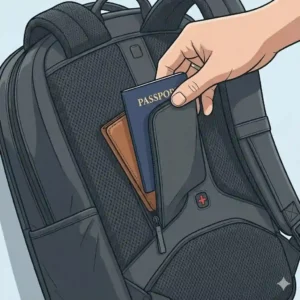
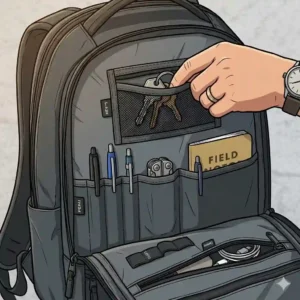
The hallmark of a great EDC user is knowing exactly where everything is without looking. Dedicate specific pockets for specific items and never change them. Keys go on the internal leash. Wallet in the hidden back-panel pocket. Earbuds in the top quick-access. Within a week, muscle memory will take over, saving you precious minutes during high-stress commutes.
Fixing Common EDC Pain Points: A Problem-Solving Guide
Even with a top-tier pack, everyday friction occurs. If your current setup is failing you, here are the real-world solutions.
Pain Point 1: The “Black Hole” Effect
The Problem: You drop a pen or a dongle into your bag, and it disappears into the dark bottom abyss.
The Solution: Stop relying entirely on the bag’s built-in organization. Invest in a brightly colored interior tech pouch (like those from Bellroy or peak Design). Furthermore, look for bags with high-visibility interior linings. Bags that use bright orange or light grey interiors reflect light, making it exponentially easier to locate small black cables at the bottom.
Pain Point 2: Erasing “Laptop Clack”
The Problem: When you set your bag down on a hard floor, you hear the terrifying “clack” of your laptop hitting the ground.
The Solution: This is a design failure of cheap bags. If your current bag does this, take a dense piece of foam or even a folded microfiber towel and place it at the bottom of the laptop compartment. When upgrading, strictly verify that the bag features a false bottom or suspended laptop sleeve, where the fabric holding the laptop ends an inch above the floor.
Pain Point 3: Damaging Clothing with Abrasive Back Panels
The Problem: You wear a nice merino wool sweater or a tailored shirt, and the friction from the backpack straps and back panel causes terrible pilling.
The Solution: Abrasive fabrics like 1000D Cordura act like sandpaper on knitwear. If you wear delicate fabrics, you must transition to bags made from smoother materials like X-Pac, 400D Nylon, or the proprietary Baida nylon used by Bellroy.
How to Choose an Everyday Carry Backpack: The Consultant’s Framework
When clients ask me for a recommendation, I don’t start with brands; I start with a rigid, logical framework. Use these four pillars to filter out marketing noise.
-
Define Your Primary Carry Volume:
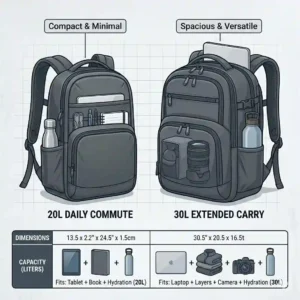
Most people overestimate what they need. If you only carry a 13-inch laptop, a charger, and a light jacket, a 15L to 18L bag is perfect. Pushing into 24L+ means you will have empty, sagging space that looks sloppy. Only move to 20L-24L if you pack gym shoes or bulky lunch containers.
-
Evaluate the “Standability” Factor:
Set the bag on the floor. Does it fall over? A bag that cannot stand on its own forces you to lean it against table legs, where it inevitably slides onto the dirty floor. A flat, structured base is a non-negotiable feature for coffee shop workers and office commuters.
-
Assess Weather Vulnerability:
Are you driving point-to-point, or walking ten blocks in Seattle? If you are a pedestrian, look for terms like “DWR coating,” “PU-coated zippers,” and “X-Pac.” If you just drive to an office parking garage, standard nylon is more than sufficient and often lighter.
-
Hardware Over Aesthetics:
Always check the zippers and buckles first. If a brand uses unbranded zippers instead of YKK or SBS, or cheap plastic hardware instead of Duraflex or Woojin, run away. A bag is only as strong as its weakest zipper.
Common Mistakes When Buying Your First Commuter Pack
Even seasoned travelers fall into traps created by clever marketing. Here are the pitfalls I constantly see.
Mistake 1: Prioritizing Features Over Comfort
A bag with 45 pockets, a built-in USB charger, and an RFID-blocking vault sounds amazing on paper. However, if the shoulder straps lack high-density EVA foam and load lifters, it will be agonizing to carry. Always prioritize the harness system (the straps and back panel) over organizational gimmicks.
Mistake 2: Buying Too Much Bag
Many buy a 30L bag thinking, “I can use it for EDC and week-long travel!” This is a fallacy. A 30L bag used for a laptop and a notebook feels like a deflated balloon and is clumsy on public transit. Buy a 20L bag for daily use, and a separate duffel or roller for travel. Do not compromise your daily comfort for an edge-case scenario.
Mistake 3: Ignoring the “Sweat Factor”
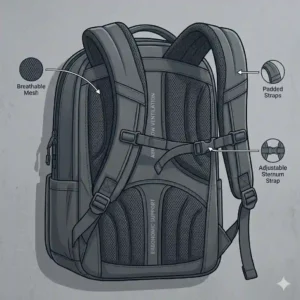
Brands love to show models wearing their bags in crisp, cool environments. The spec sheet won’t tell you this, but flat, non-channeled back panels will soak your shirt with sweat in 75-degree weather. Look for molded air-channels or suspended mesh backs if you run hot or bike to work.
Material Science: Cordura vs. X-Pac vs. Ballistic Nylon
Understanding backpack materials is crucial. You aren’t just paying for a brand logo; you are paying for the textile engineering. Check reputable sources like Wikipedia’s entry on Ballistic Nylon or deep-dives on Pack Hacker to understand these textiles, but here is the practical breakdown:
1680D Ballistic Nylon:
Originally developed for WWII flak jackets, this material is heavy, incredibly tear-resistant, and has a sleek, slight sheen. It is perfect for office environments because it repels dirt and dog hair brilliantly. The downside? It is heavy.
1000D Cordura:
This has a matte, canvas-like texture. It is the king of abrasion resistance. If you scrape it against a brick wall, the wall will likely take more damage. However, as mentioned earlier, it is stiff, abrasive to clothing, and acts like a magnet for pet hair and dust.
X-Pac (Sailcloth):
A modern, laminated fabric characterized by a subtle diamond grid pattern. It is completely waterproof (not just water-resistant) and extremely lightweight. The “why” behind X-Pac’s popularity is its structure; it holds its shape perfectly even when empty. The trade-off is that it crinkles slightly when moved, sounding a bit like a heavy tarp.
What to Expect: Real-World Ergonomics and Performance
When we talk about an everyday carry backpack, we must discuss biomechanics. A bag changes your center of gravity.
A poorly designed bag pulls backward, forcing your neck to crane forward to compensate, leading to tension headaches. Premium bags, like the Aer City Pack Pro and the GORUCK GR1, utilize contoured straps that curve naturally around the ribcage.
Furthermore, pay attention to the “sternum strap.” A sternum strap doesn’t just keep the shoulder straps from slipping; it actively pulls the weight inward, aligning the load with your spine. If you walk more than a mile a day, a removable, adjustable magnetic sternum strap is an absolute game-changer. Finally, weight placement matters. The heaviest item (your laptop) must sit as close to your back as physically possible. If a bag places the laptop sleeve on the outer edge of the pack, the leverage will multiply the perceived weight. Avoid that design at all costs.
Features That Actually Matter (And Marketing Hype to Ignore)
Let’s filter the noise. What actually dictates a good user experience?
Features That Matter:
-
False-Bottom Laptop Sleeve: Protects your $2,000 device from the floor. Non-negotiable.
-
High-Visibility Interior: A neon orange or light grey interior lining. It acts like a flashlight, allowing you to see your gear in the dark.
-
Quick-Access Top Pocket: A small, fleece-lined pocket near the top handle for sunglasses, phone, and keys. You will use this pocket more than the rest of the bag combined.
-
Luggage Pass-Through: A strap on the back panel that slides over a rolling suitcase handle. Essential for hybrid travel.
Hype to Ignore:
-
Built-in USB Ports: These are universally terrible. They use cheap, slow-charging cables that break within six months and cannot be easily replaced. Just carry a good portable power bank.
-
Anti-Theft Combination Locks: Unless you are traveling through highly specific pickpocket zones, built-in locks just slow you down daily. A simple carabiner clipping two zippers together is faster and deters 99% of casual thieves.
-
“TSA-Friendly” Lay-Flat Laptop Compartments: TSA regulations frequently change, and half the time, agents make you take the laptop completely out anyway. Don’t base a purchase on this feature.
Long-Term Cost & Maintenance: The Lifecycle of a Premium Pack
When you spend $250 on an everyday carry backpack, you are making an investment. Calculating the “Total Cost of Ownership” changes how you view that upfront price.
A $50 fast-fashion bag will likely suffer a blown zipper or torn strap within 12 months of daily use. Over five years, you buy five bags, spending $250, while enduring the frustration of broken gear.
A premium bag from Aer, GORUCK, or Peak Design will easily last 5 to 10 years. The Total Cost of Ownership drops to $25-$50 per year.
Year One Maintenance:
Around month six, you will notice dirt buildup. Do not put a premium structured bag in the washing machine; the agitator will destroy the EVA foam and warp the frame sheet. Instead, fill a bathtub with lukewarm water and mild dish soap. Submerge the bag, scrub the nylon with a soft bristle brush, and hang it upside down in the shower to air dry.
Year Three and Beyond:
The polyurethane coating on water-resistant zippers may begin to flake around year three. You can rejuvenate the water resistance of the main nylon body by spraying it with a DWR (Durable Water Repellent) refresh spray, commonly found at outdoor retailers like REI.
✨ Don’t Miss These Exclusive Deals!
🔍 Secure your ultimate daily companion today! Click on any highlighted item to check current pricing and availability. These bags will transform your commute and protect your most valuable tech!
Conclusion
Finding the perfect everyday carry backpack is a transformative experience. It elevates your daily routine from a disorganized scramble into a streamlined, professional process. Whether you opt for the tech-forward brilliance of the Aer City Pack Pro, the absolute invincibility of the GORUCK GR1, or the budget-friendly versatility of The North Face Recon, the key is matching the bag’s specific engineering to your personal daily friction points.
Stop settling for bags that hurt your shoulders, leave your laptop vulnerable, and bury your keys in a black hole. Invest in a tool that respects your gear and your spine. You have the expert framework; now it is time to make the upgrade.
FAQs
❓ What size everyday carry backpack do I need?
✅ For most urban commuters carrying a laptop, water bottle, tech pouch, and light jacket, a 15L to 21L backpack is ideal. Anything larger than 24L becomes bulky and sags when not fully packed, making it cumbersome on public transit…
❓ Are messenger bags better than everyday carry backpacks?
✅ Backpacks are vastly superior for ergonomics and spinal health. Messenger bags place asymmetrical weight on one shoulder, causing neck fatigue over time. However, messenger bags do offer slightly faster access to gear without taking the bag off…
❓ Can I wash my everyday carry backpack in a washing machine?
✅ No. Machine washing can destroy the internal foam padding, warp the laptop frame sheet, and strip the DWR water-resistant coating. Always spot-clean with mild soap and warm water, or hand-wash in a tub and air dry…
❓ What does 1680D or 1000D mean on a backpack?
✅ The “D” stands for Denier, a measurement of yarn thickness. Higher numbers generally mean thicker, more abrasion-resistant fabric. 1680D nylon is incredibly tough but slightly heavy, making it a standard for premium, long-lasting commuter bags…
❓ Are waterproof zippers actually waterproof?
✅ High-end YKK AquaGuard zippers are highly water-resistant, not fully waterproof. They will easily survive a heavy 30-minute rainstorm, but if you submerge the bag in a river, water will eventually seep through the teeth…
Recommended for You
- 5 Top-Tier Concealed Carry Backpacks for 2026: An Expert’s Uncensored Guide to Maximum Security & Comfort
- 7 Best Minimalist Backpack Everyday Carry Guide for 2026
- 5 Best backpack organizer Inserts to Upgrade Your Carry in 2026
Disclaimer: This article contains affiliate links. As an Amazon Associate, I earn from qualifying purchases. If you purchase products through these links, we may earn a small commission at no additional cost to you.
✨ Found this helpful? Share it with your friends! 💬🤗
[addtoany]
