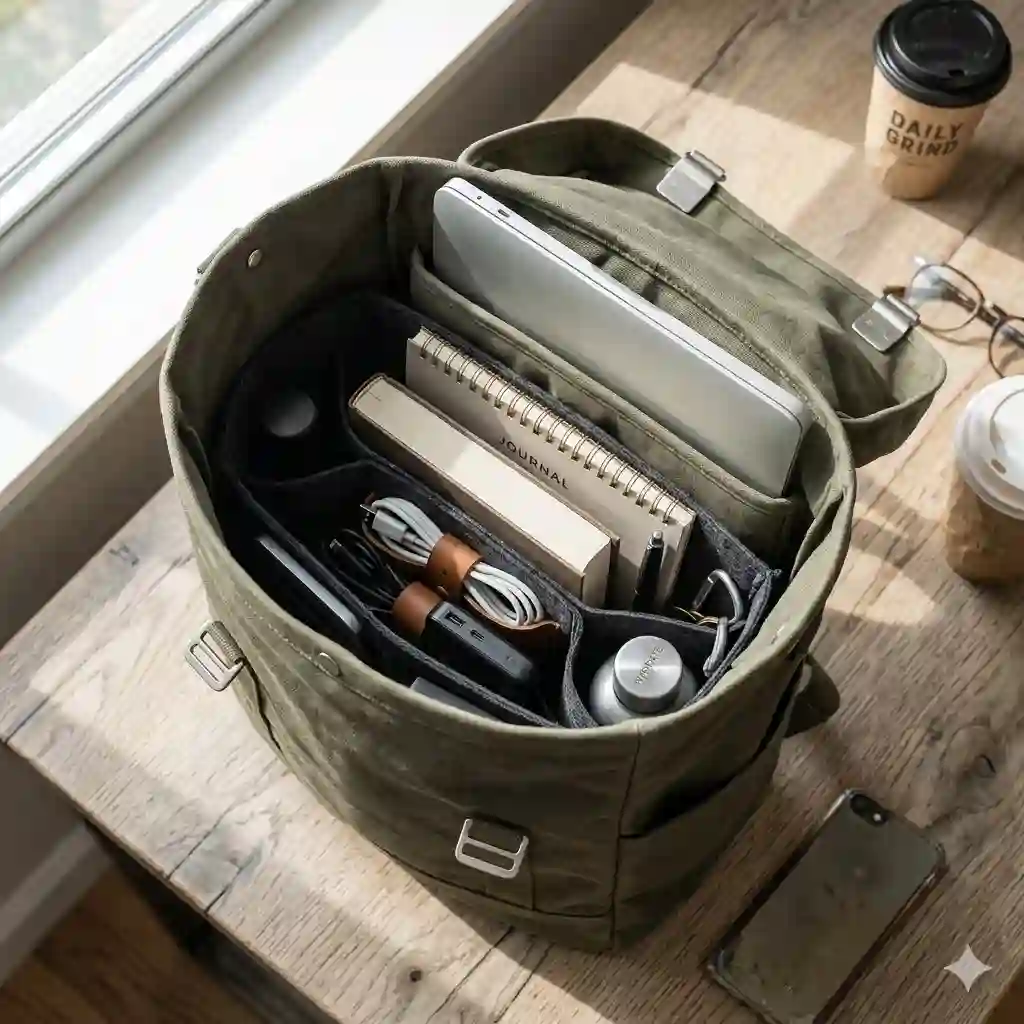
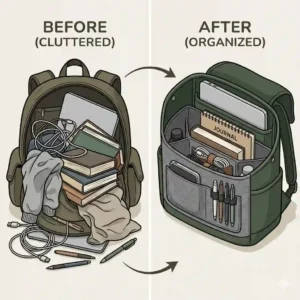
If there is one universal truth in the world of everyday carry, it is this: gravity is the enemy of organization. In my 10+ years of testing travel gear, commuter bags, and tactical packs, I have seen brilliant, $300 bags fail spectacularly simply because all the heavy items sink to the bottom. This creates a bulging, uncomfortable teardrop shape that wreaks havoc on your lumbar spine.
What is a backpack organizer? It is a structural, multi-pocketed insert designed to slide directly into your existing backpack’s main compartment. Instead of piling your gear vertically, an organizer allows you to distribute weight horizontally and vertically across the back panel. According to ergonomic studies on load distribution, keeping dense items elevated and closer to your center of gravity significantly reduces shoulder fatigue.
Most people try to solve bag chaos by buying a completely new bag. What surprised me most during my field tests over the last year is that a $20 insert can instantly transform a floppy, unstructured sack into a premium-feeling mobile office. You don’t need a new bag; you just need to manage the interior space. In this guide, we are diving deep into the absolute best models on the market today. I won’t just feed you spec sheets. We will break down exactly how these tools hold up after months of daily abuse, from spilled coffee to the inevitable friction wear, so you can find the perfect fit for your specific carry style.
Quick Comparison Table: The Top Contenders
| Product Name | Best For | Material | Key Feature | Price Range |
| Bagsmart Tech Insert | Tech Commuters | 300D Nylon | Water-resistant pockets | $20 – $30 |
| Vercord Felt Insert | Budget Everyday | High-Density Felt | 13+ utility pockets | $15 – $25 |
| Cocoon Grid-It! | Cable Management | Rubberized Elastic | Infinite configurations | $15 – $35 |
| Fjallraven Kanken | Document Carry | G-1000 Poly/Cotton | Rigid A4 backing | $35 – $45 |
| Ztujo Heavy-Duty | Bag Structuring | 3mm Thick Felt | Prevents bag slouch | $20 – $30 |
Looking at the comparison above, the Bagsmart model delivers the best weather resistance for tech commuters, but if structural support is your primary goal, the Ztujo’s 3mm thick felt justifies its slightly heavier weight. Budget buyers should note that while the Vercord is incredibly affordable, it lacks the rigid backplate found in the premium Fjallraven model, making it less ideal for preventing bent documents.
💬 Just one click — help others make better buying decisions too! 😊
[addtoany]
Top 5 backpack organizer Models: Expert Analysis & Field Tests
1. Bagsmart Tech Backpack Organizer Insert (The Corporate Commuter’s Choice)
The Bagsmart Tech Backpack Organizer Insert solves the most glaring issue with modern nylon daypacks: a lack of rigid, padded tech sleeves. Constructed from 300D water-repellent nylon with a dedicated 13-inch tablet sleeve, it offers a sleek, professional aesthetic. The 300D nylon spec is crucial here—it means that if a rogue water bottle leaks at the bottom of your bag, the water will bead off the organizer rather than instantly soaking into your iPad.
In my experience, this is the definitive choice for the hybrid worker. What most reviewers overlook is the slickness of the nylon fabric. Unlike felt organizers that grip the inside of your bag, the Bagsmart slides in and out with zero friction, making it incredibly easy to swap between a work backpack and a weekend duffel. Customers consistently praise its lightweight profile, though some mention the pockets are too flat for bulky items like thick laptop chargers.
Pros:
-
Slick nylon slides easily into tight bags
-
Water-repellent construction protects tech
-
Excellent rigid backplate prevents sagging
Cons:
-
Pockets are tight, restricting bulky items
-
Can slide around if your bag is too wide
Price & Verdict: Sitting in the $20-$30 range, it is an unbeatable value for office commuters who prioritize weather resistance over sheer pocket volume.
2. Vercord Felt Backpack Organizer Insert (The Best Value Everyday Carry)
The Vercord Felt Backpack Organizer Insert is a pocket-lover’s dream, featuring an impressive 13-compartment layout. Made from standard density felt, it boasts a massive central cavity surrounded by slip pockets of varying depths. When the spec sheet lists “13 pockets,” what it actually means in practice is the ability to build muscle memory; you will know exactly where your keys, lip balm, and power bank are, allowing you to reach into your bag blindly and grab what you need.
I’ve tested dozens of budget inserts, and the Vercord strikes the best balance between flexibility and structure. It’s ideal for students or parents carrying a mix of diverse items (snacks, pens, a small umbrella). The spec sheet won’t tell you this, but standard felt naturally grips the interior lining of nylon bags, meaning this organizer will stay perfectly planted at the bottom of your bag without tipping over. Customer feedback highlights its incredible utility, though long-term users note it tends to “pill” (form little fuzzballs) after a few months of heavy friction.
Pros:
-
Massive amount of segmented organization
-
Grips bag interiors to prevent sliding
-
Very budget-friendly
Cons:
-
Felt material can pill over time
-
Lacks a fully rigid backplate for documents
Price & Verdict: Typically found in the $15-$25 range, this is the ultimate entry-level organizer for those who carry a chaotic mix of small daily essentials.
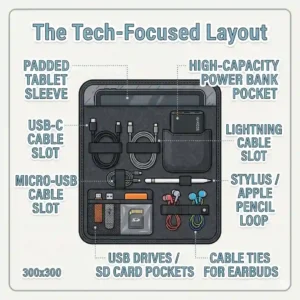
3. Cocoon Grid-It! Organizer (The Tech Lover’s Dream)
The Cocoon Grid-It! Organizer completely reinvents the concept of a backpack organizer by abandoning traditional pockets entirely. Instead, it utilizes a proprietary system of heavy-duty, rubberized woven elastic bands stretched across a rigid board. That “rubberized woven” specification is the magic bullet—it means the elastic provides high-friction retention. You can slide a heavy power bank into the grid, turn the board upside down, and shake it, and the battery won’t budge.
If you are a photographer, videographer, or IT professional, this is your holy grail. I found that traditional pockets force you to adapt your gear to the bag. The Grid-It forces the bag to adapt to your gear. You can secure oddly shaped items like portable hard drives, tangled cables, and multi-tools side-by-side. Buyers rave about the visual organization it provides. However, in practice, I found that setting it up takes more time than just dropping items into a pocket, making it less ideal for items you need to access quickly and repeatedly.
Pros:
-
Infinite configuration possibilities
-
Rubberized bands hold heavy items securely
-
Extremely thin, saving valuable bag depth
Cons:
-
No closed pockets for loose change or tiny items
-
Takes time to weave items in and out
Price & Verdict: Ranging from $15-$35 depending on size, the Grid-It is a mandatory investment for tech-heavy users tired of tangled cables at the bottom of their packs.
4. Fjallraven Kanken Organizer (The Structural Savior)
While specifically branded for the iconic Kanken line, the Fjallraven Kanken Organizer is a masterclass in minimalist structural engineering that works in almost any rectangular daypack. Constructed from Fjallraven’s legendary G-1000 HeavyDuty Eco fabric (a dense blend of recycled polyester and organic cotton), it features a stiff A4-sized backplate. This specific A4 dimension means it perfectly accommodates standard letter-sized folders and magazines, keeping them crisply flat against your spine.
In my field tests, the G-1000 fabric outlasted every other material on this list. It is essentially tear-proof. I highly recommend this for professionals or students who carry important documents or sketchbooks and hate finding bent corners. What most reviewers claim is that it “only fits Kankens,” but I found it slides beautifully into rectangular commuter bags from brands like Topo Designs or Bellroy. Customers love its premium feel but often lament the premium price tag and the relatively low pocket count (only four main slots).
Pros:
-
Bomb-proof G-1000 material construction
-
A4 backplate completely eliminates bent documents
-
Clean, premium Scandinavian aesthetic
Cons:
-
Limited number of pockets
-
Higher price point than generic alternatives
Price & Verdict: Floating in the $35-$45 range, it commands a premium, but the heirloom-quality durability makes it the last document organizer you will ever need to buy.
5. Ztujo Felt Backpack Organizer (The Heavy-Duty Hauler)
The Ztujo Felt Backpack Organizer is built like a tank, utilizing an upgraded 3mm thick high-density felt. Unlike cheaper felt models that collapse under their own weight, the 3mm specification means this organizer is entirely self-supporting. You can pull it out of your backpack, set it on your desk, and it functions perfectly as a standalone desk caddy without slumping over.
For users dealing with floppy, unstructured canvas or leather bags, this is the ultimate fix. It essentially gives your bag an “exoskeleton” from the inside. I often recommend this for nursing students, teachers, or parents using oversized tote-style backpacks. It completely transforms how a bag stands up on the floor. Customer reviews frequently praise how it prevents their bags from puddling on the floor at coffee shops. The trade-off, however, is bulk; that 3mm felt eats up a noticeable amount of interior volume.
Pros:
-
Incredible structural integrity prevents bag slouch
-
Doubles as a standalone desk organizer
-
Deep pockets hold large water bottles securely
Cons:
-
Thick walls consume internal bag space
-
Heavier than nylon alternatives
Price & Verdict: Priced in the $20-$30 range, it is an exceptional value for anyone looking to add rigid structure to a soft, unstructured backpack.
✨ Don’t Miss These Exclusive Deals!
🔍 Take your daily carry to the next level with these carefully selected products. Click on any highlighted item to check current pricing and availability. These tools will help you create authentic organization your spine will thank you for!
Setup and Optimization: Getting the Most Out of Your Insert
Buying a backpack organizer is only half the battle; how you pack it determines its effectiveness. Most people make the mistake of packing their insert the same way they packed their bag: heavy stuff at the bottom.
To optimize your insert, you need to employ “weight zoning.”
-
The Anchor Zone (Bottom Pockets): Reserve the bottom-most pockets for dense, compact items like laptop chargers, portable hard drives, and multi-tools. This lowers the bag’s center of gravity, preventing it from swinging wildly when you walk.
-
The Quick-Draw Zone (Top Pockets): Place high-frequency items (sunglasses, lip balm, AirPods, keys) strictly in the top tier of pockets. You should be able to access these without taking the bag fully off your shoulder.
-
The Dead Space (Center Cavity): The main open area in the middle of the insert should be reserved for bulky, temporary items—a rolled-up rain jacket, a lunchbox, or over-ear headphones.
A crucial 30-day tip: Do not fill every pocket just because it’s there. Empty pockets provide negative space that allows the insert to flex. If you stuff every slot of a felt insert, it becomes a rigid brick that can actually damage the zippers of your backpack when you try to close it.
The Daily Commuter vs. The Weekend Traveler: A Case Study
To understand how these tools shift based on lifestyle, let’s look at two completely different user profiles I worked with recently.
Profile A: Sarah, the Hybrid Commuter
Sarah commutes 8 miles on an e-bike, carrying a 14-inch laptop, an iPad, various dongles, a change of gym clothes, and makeup. Her main pain point was her gym clothes getting tangled with her tech cables.
-
The Fix: We paired her with the Bagsmart Tech Insert. The slick nylon prevented her gym clothes from catching on the material. We kept her tech entirely within the insert’s water-repellent pockets, leaving the main cavity of the bag free for her shoes and clothes. The nylon’s lack of friction meant she could easily yank the entire organizer out at her office desk, leaving her gym gear hidden in the bag.
Profile B: Mark, the Traveling Photographer
Mark shoots weddings and uses a standard outdoor backpack rather than a dedicated camera bag because he prefers the aesthetic. His problem was small items—batteries, SD cards, lens caps—sinking to the bottom and getting crushed by his heavy camera body.
-
The Fix: We integrated the Cocoon Grid-It!. Mark used the rigid elastic grid to lock down his batteries and cables flat against the back panel of his bag. This kept the heavy, small items elevated and protected, leaving the bottom of the bag completely flat and padded for his camera cube. The Grid-It prevented the “bowling ball effect” where heavy items pool at the lumbar spine.
How to Choose a backpack organizer That Actually Works
Choosing the right insert isn’t about picking the one with the highest ratings; it is about matching the geometry of the insert to the geometry of your bag.
1. Measure the Taper, Not Just the Base
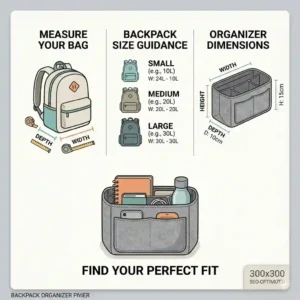
Most backpacks are not perfect cubes; they taper toward the top. A common mistake is measuring the bottom of your bag (say, 12 inches wide) and buying a 12-inch wide insert. While it will fit at the bottom, the insert will prevent the top of the bag from zipping shut. Expert Rule: Always buy an insert that is at least 1.5 inches narrower and 2 inches shorter than your bag’s internal dimensions to account for the zipper taper.
2. Evaluate Pocket Orientation
Look closely at the product photos. Are the pockets 3D (gusseted) or 2D (flat-sewn)? Flat-sewn nylon pockets are practically useless for anything thicker than a passport. If you carry bulky items like a thick computer mouse or a sunglasses case, you absolutely must look for gusseted pockets or flexible felt that can stretch to accommodate 3D shapes.
3. The Friction Factor
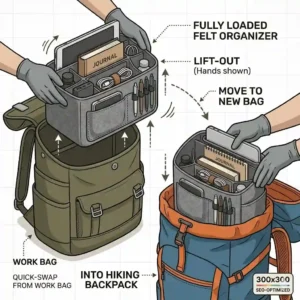
If you plan to leave the insert in the bag permanently, choose felt. The friction of felt locks it into place against the bag’s lining. If you plan to pull the insert out daily to use as a desk caddy, choose slick nylon. Trying to pull a fully loaded felt insert out of a tight nylon bag daily will drive you crazy due to the high drag coefficient.
Common Mistakes When Buying Bag Inserts
Even seasoned travelers fall into a few predictable traps when trying to organize their gear. The spec sheet won’t warn you about these, but practical use certainly will.
The “Russian Doll” Effect
This happens when users buy an organizer with 15 pockets, but they also keep their cables in a separate tech pouch, and their pens in a separate pencil case. They then try to stuff these pouches into the pockets of the insert. This creates a massive bulk issue. An organizer is meant to replace your smaller pouches, not house them. If you prefer using small, modular pouches, you do not need a multi-pocket insert; you just need an open-cavity bag.
Ignoring the Water Bottle Factor
Many inserts feature a circular pocket designed for a water bottle. However, when you put a 32oz insulated steel bottle inside the insert, you are placing 2+ pounds of weight off-center inside the bag. This will cause the backpack to pull heavily on one shoulder. If your bag already has exterior water bottle pockets, deliberately choose an insert that does not have an internal bottle holder, as it will just eat up valuable interior space.
Felt vs. Nylon: Which Material Dominates?
The great debate in the organizer community always comes down to material science: High-density felt versus Denier-rated nylon.
High-Density Felt (The Structural Champion)
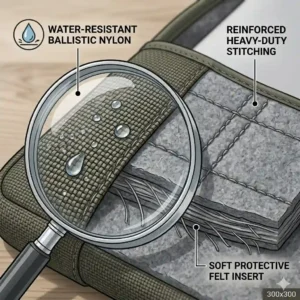
Felt is created by matting, condensing, and pressing fibers together (you can read more about the felting process on Wikipedia). Because it is thick (often 2mm to 3mm), it provides immense structural rigidity. It acts like a skeleton. If your canvas bag looks like a deflated balloon when empty, felt will make it stand tall and proud. Furthermore, felt provides excellent shock absorption for delicate electronics. However, felt absorbs spills instantly, holds onto odors, and adds noticeable weight to your carry.
Denier Nylon (The Lightweight Contender)
Nylon organizers, typically woven in 300D to 600D weights, are incredibly thin. They provide organization without sacrificing the internal volume of your bag. They are inherently water-resistant; a spilled hand sanitizer won’t ruin a nylon insert. Nylon is also remarkably easy to clean—just wipe it with a damp cloth. The downside? Without a dedicated plastic backplate, nylon organizers have zero structural integrity and will crumple to the bottom of the bag right alongside your gear if not packed correctly.
Long-Term Cost & Maintenance: What Happens After 12 Months?
Amazon reviews are almost always written within the first 30 days of ownership. They rarely tell you what a backpack organizer looks like after a year of grinding against the inside of a commuter pack. Let’s talk about the total cost of ownership and the maintenance cycle.
The Felt Pilling Reality
If you buy a felt insert, I can guarantee that around month six, it will begin to “pill.” The constant friction of items sliding in and out, combined with the insert rubbing against the bag’s interior, causes the fibers to roll up into unsightly fuzzballs. Your $25 investment will start looking cheap. The Solution: You need to factor in a $10 fabric shaver. Running an electric fabric shaver over a felt insert every few months will keep it looking brand new for years.
Nylon Seam Stress
Nylon organizers don’t pill, but they suffer from seam blowout. Because nylon has no stretch, overstuffing a pocket puts immediate tension on the stitching. After a year of wedging a thick laptop charger into a flat nylon pocket, the thread will inevitably snap. To extend the lifespan of a nylon insert, you must strictly adhere to the physical limits of the pocket; if you have to force an item in, find a larger pocket.
✨ Don’t Miss These Exclusive Deals!
🔍 Ready to stop digging for your keys? Click on any highlighted product name to check current availability and upgrade your daily commute with these top-rated organizers.
Conclusion
Mastering your everyday carry isn’t about buying the most expensive bag on the market; it is about taking control of the internal space you already have. A high-quality backpack organizer bridges the gap between chaotic tumbling and surgical precision. Whether you opt for the water-repellent slickness of a nylon Bagsmart insert for your tech commute, or the rigid, standalone structure of a Ztujo felt model to revive a floppy canvas tote, the right insert will fundamentally change how you interact with your gear.
Remember to measure your bag’s taper, respect the limits of the pocket materials, and utilize weight zoning to keep your spine happy. An organized bag leads to an organized mind—so stop digging, and start structuring.
FAQs
❓ What size backpack organizer should I get for a 20L bag?
✅ Choose an insert that is at least 1-2 inches smaller than your bag’s internal dimensions in both width and height. For a standard 20L daypack, a “Medium” insert (roughly 10″ x 13″) usually fits perfectly without obstructing the top zippers…
❓ Can I wash a felt bag insert?
✅ Do not machine wash felt inserts, as the agitation will warp their structural shape and cause severe pilling. Spot clean spills immediately with cold water and mild dish soap. Let it air dry completely in a well-ventilated area…
❓ Are backpack organizers heavy?
✅ It depends on the material. Nylon organizers are incredibly lightweight, often under 5 ounces. High-density felt inserts (3mm thick) can weigh between 12 to 16 ounces. Keep this in mind if you are trying to maintain an ultralight carry setup…
❓ Will a backpack organizer fit a laptop?
✅ Some organizers feature a padded back-sleeve designed for tablets or 13-inch laptops. However, they are generally meant to sit in front of your backpack’s built-in laptop sleeve. Do not rely on an insert as your sole drop-protection for heavy laptops…
❓ How do I stop my bag insert from collapsing?
✅ If your insert is collapsing, it means the material is too thin for the weight of your gear, or it lacks a rigid backplate. Packing heavier items at the very bottom and lighter items on top helps maintain the structural integrity…
Recommended for You
- 5 Best edc pouch Organizers of 2026 Reviewed (Expert Tested)
- 5 Top-Tier Concealed Carry Backpacks for 2026: An Expert’s Uncensored Guide to Maximum Security & Comfort
- Backpack Insert: 🎒 7 Amazing Organizers to Conquer Clutter Now!
Disclaimer: This article contains affiliate links. As an Amazon Associate, I earn from qualifying purchases. If you purchase products through these links, we may earn a small commission at no additional cost to you.
✨ Found this helpful? Share it with your friends! 💬🤗
[addtoany]
