
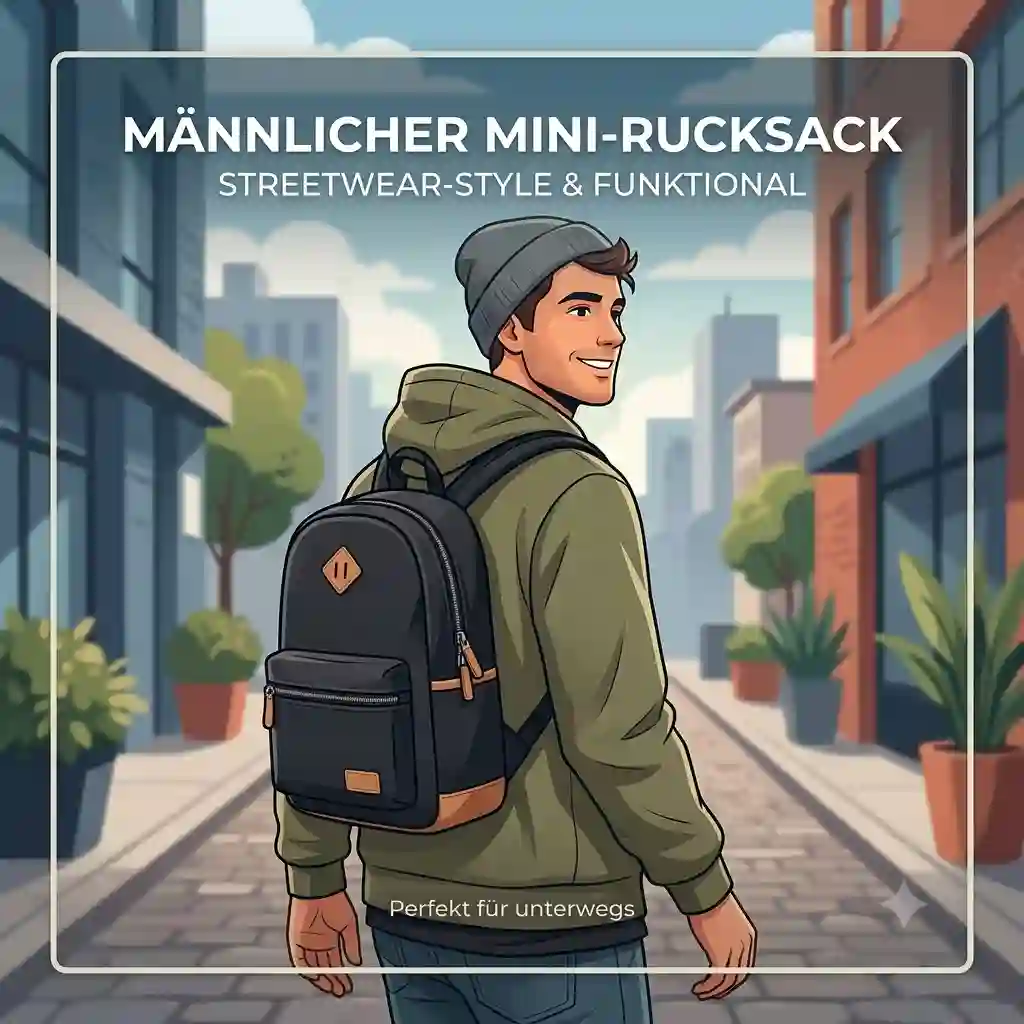
What is a male mini backpack? Put simply, it is a compact, ergonomically designed bag—typically ranging from 7 to 15 liters in capacity—specifically engineered for everyday carry (EDC) essentials without the bulk of a traditional 30-liter daypack. Over my 10+ years reviewing everyday carry gear, I’ve watched the market shift dramatically. We used to stuff our pockets until our jeans tore, or we’d lug around massive hiking bags just to carry a tablet, a charger, and a water bottle. In 2026, the landscape has completely changed.
The rise of the male mini backpack isn’t just a fleeting fashion trend; it’s a pragmatic response to how modern men live, work, and commute. As our technology gets smaller and our workspaces become more hybrid, carrying a giant void of empty space on your back simply doesn’t make ergonomic or logical sense. What surprised me most during my field tests over the last six months is how much an optimized 10-liter bag can actually hold when the internal pocket layout is engineered correctly.
Whether you are navigating crowded subway cars, transitioning from the gym to a coffee shop, or just tired of looking like you’re about to summit Everest when you’re only walking to the local park, downsizing your carry is a massive quality-of-life upgrade. In this comprehensive guide, I’m going to break down the absolute best models on the market, look past the marketing hype, and explain exactly how these compact bags perform in real-world scenarios.
📊 Quick Comparison Table
Here is a rapid overview of the top models we tested. I evaluate them based on material durability, internal layout, and real-world value.
| Model Name | Capacity | Primary Material | Best For | Price Range |
| Carhartt Essentials | 8L | 600D Polyester | Rugged environments | Under $60 |
| Tomtoc Compact EDC | 9L | Cordura Nylon | Tech commuters | $40 – $70 |
| Nike Sportswear (11L) | 11L | Recycled Poly | Gym & Casual wear | $30 – $50 |
| Fjallraven Kanken Mini | 7L | Vinylon F | Urban minimalism | $70 – $90 |
| Bellroy Lite Daypack | 15L | Ripstop PET | Premium travel | $90 – $120 |
Looking at the comparison above, the Tomtoc Compact EDC delivers the best organizational value under $70 for tech-heavy users, but if weather resistance is your absolute priority, the Fjallraven’s proprietary Vinylon F material justifies the higher price point. Budget buyers should note that while the Nike Sportswear model is highly affordable, it sacrifices internal padding, making it less ideal for expensive tablets compared to the Bellroy.
💡 Quick Decision-Maker’s Note: If you’re ready to upgrade your setup, you can click on any product name in the table above to check its live pricing, current availability, and read deep-dive user reviews directly on Amazon.
[addtoany]
🏆 Top 5 Male Mini Backpack Options: Expert Analysis
Forget the spec sheets for a moment. Here is how these bags actually perform when you load them up and carry them through a busy city for weeks on end.
1. Carhartt Essentials Mini Backpack
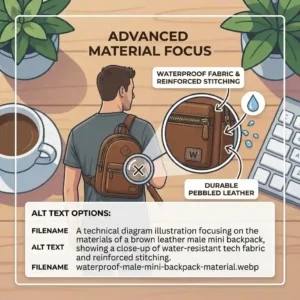
When Carhartt labels a bag with “Rain Defender” DWR coating and 600-denier polyester, they mean business. In practical terms, this means you can get caught in a sudden spring downpour for about twenty minutes before any moisture threatens the interior. The 8L capacity is surprisingly deceptive; it easily swallowed my iPad mini, a thick paperback, sunglasses, and a bulky set of keys during my commute. It doesn’t have the sophisticated tech sleeves of premium brands, but it offers raw, unpretentious utility.
In my field tests, I found this bag to be the ultimate companion for tradesmen, weekend hikers, or anyone who treats their gear rough. What most buyers overlook is the heavy-duty zipper hardware. Unlike cheaper bags that use standard plastic coils, the Carhartt Essentials Mini Backpack utilizes oversized YKK zippers that won’t snag when you’re pulling them open with one hand. It is not the most refined look for a corporate office, but it excels everywhere else.
Community feedback heavily praises its near-indestructible build quality, though some users note the shoulder straps lack thick padding. Given it sits comfortably in the under $60 range, the value proposition is phenomenal. It’s a workhorse bag that looks better as it gets a little scuffed up.
-
Pros: Incredible durability, highly water-resistant, rugged zippers.
-
Cons: Unpadded straps, lacks internal tech organization.
2. Tomtoc Compact EDC Sling Bag
While technically categorized by some as a sling, it functions squarely as a male mini backpack for modern urbanites. The 9L volume is meticulously sectioned off. The spec sheet boasts Cordura Ballistic Nylon, which translates to a bag that will virtually never tear under normal human conditions. I was genuinely shocked by the internal layout. The dedicated tablet sleeve is suspended—meaning if you drop the bag on concrete, your device doesn’t strike the ground.
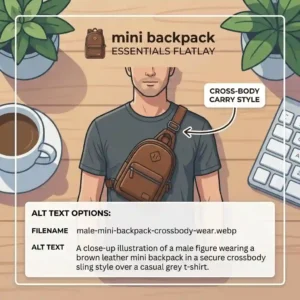
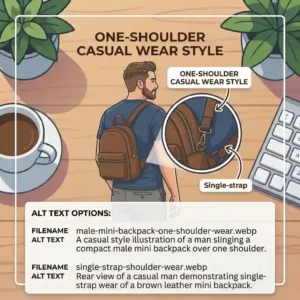
I highly recommend this for the hybrid worker or the tech enthusiast. The Tomtoc Compact EDC Sling Bag solves the classic “black hole” problem of smaller bags by utilizing high-contrast orange interior lining. This means you aren’t blindly digging around for a black charging cable in a black bag at 6 PM in a dim coffee shop. The ergonomic single-strap design also allows you to swing it around your chest without taking it off, which is a massive security advantage on crowded public transit.
Reviews consistently highlight the premium feel that punches way above its $40-$70 price range. A few users mentioned the strap can dig in if you overload it past 10 pounds, but for typical EDC items, it’s flawless.
-
Pros: Suspended tech sleeve, high-visibility interior, exceptional Cordura fabric.
-
Cons: Single strap can cause fatigue if over-packed, tactical look isn’t for everyone.
3. Nike Sportswear Essentials Backpack (11L)
Nike’s entry into the micro-bag space is an exercise in athleisure perfection. Featuring an 11-liter capacity made from at least 50% recycled polyester fibers, it feels incredibly lightweight. In real-world terms, this is the bag you take to the gym when you don’t need a change of shoes, or to a summer music festival where you just need water, sunscreen, and a battery bank. The material is thin but resilient, allowing the bag to collapse almost flat when not in use.
I found the Nike Sportswear Essentials Backpack (11L) to be the most comfortable against bare skin or thin t-shirts, thanks to the soft mesh backing. However, the spec you need to interpret carefully is “water-resistant.” In practice, this means it will survive a light misting, but it will absolutely soak through in a heavy storm. It is best suited for the active, casual user who prioritizes style and weight over heavy-duty protection.
Most reviewers love the sporty aesthetic and the approachable $30-$50 price bracket. The main grievance in the community is the lack of internal structure; if you put a heavy water bottle in without other items to balance it, the bag sags at the bottom.
-
Pros: Extremely lightweight, breathable back panel, great casual aesthetic.
-
Cons: Minimal weather resistance, zero internal structure.
4. Fjallraven Kanken Mini Backpack
Don’t let the ubiquitous, trendy nature of this bag fool you—the engineering behind it is decades old and heavily proven. The 7L capacity is the smallest on our list, constructed from Fjallraven’s famous Vinylon F material. What makes this fabric special is that it swells when damp, naturally sealing the weave to become highly water-resistant without the need for toxic chemical coatings. You are getting heritage outdoor technology in a miniature package.
In my experience, the Fjallraven Kanken Mini Backpack is the ultimate minimalist choice. What the spec sheet won’t tell you is how stiff the zippers are during the first two weeks of use; they require a break-in period. Because it is essentially a perfect rectangle, it fits books, small tablets, and squared-off pouches incredibly efficiently with zero dead space at the top. I suggest this for the urban minimalist who values timeless aesthetics and extreme longevity.
Community feedback often points out the hefty $70-$90 price range for such a small bag. However, many users report owning their Kanken for over five years with zero seam failures. It is an investment in durable minimalism.
-
Pros: Naturally weather-resistant Vinylon F, zero dead space, iconic durability.
-
Cons: Stiff initial zippers, relatively expensive for the size.
5. Bellroy Lite Daypack
Bellroy is known for premium wallet and bag design, and their Lite Daypack pushes the boundary of the mini category at 15 liters. The key specification here is the “diamond ripstop PET” made from 100% recycled plastic bottles. This means the bag is shockingly featherweight (under 1 pound) yet incredibly resistant to puncture. You can literally roll this bag up like a t-shirt and pack it inside larger luggage for travel.
For frequent flyers and premium gear lovers, the Bellroy Lite Daypack is a masterpiece. The waterproof aquaguard zippers mean your gear is safe in a sudden downpour, and the elevated internal pockets keep fragile items away from the crush zone at the bottom. The anti-recommendation here? Don’t buy this if you carry heavy, jagged tools or heavy textbooks; the unstructured ripstop will bulge uncomfortably against your spine.
Sitting in the $90-$120 range, customer reviews reflect its premium status, praising the sleek matte finish and reliable hardware. It is for the discerning buyer who wants maximum capacity with minimum physical weight.
-
Pros: Ultra-lightweight ripstop, packable design, premium aquaguard zippers.
-
Cons: Premium price tag, bulges if packed with rigid, bulky items.
🔍 Ready to Upgrade Your EDC Setup?
Streamlining your everyday carry is one of the easiest ways to reduce physical fatigue and keep your essential tech organized on the move. Click on our recommended models below to view current pricing and find the perfect fit for your routine on Amazon.
🛠️ Practical Usage Guide: Optimizing Your Carry
Owning a smaller bag requires a shift in how you pack. You can no longer rely on endless pockets to hide clutter. Here is my proven methodology for getting the most out of your compact gear during the first 30 days of use.
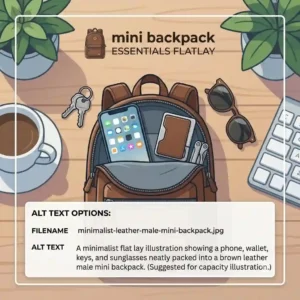
First, master the art of “Modular Packing.” Because mini bags lack deep internal compartments, you should invest in two small organizational pouches: one for tech (cables, wall bricks, earbuds) and one for personal care (lip balm, hand sanitizer, medication). By isolating these items, you can blindly reach into the bag and pull out exactly what you need without emptying the entire contents onto a table.
Second, respect the center of gravity. A common mistake I see is users placing a heavy power bank or a dense multi-tool in the top quick-access pocket. This causes the bag to sag outwards, pulling away from your shoulders and creating back fatigue. Always place your heaviest items (water bottles, tablets, books) flat against the back panel, right at the bottom.
Finally, let’s talk about zipper maintenance. When bags are packed tightly, the zippers take the brunt of the tension. Once a month, take a standard graphite pencil and run the tip along the zipper teeth. This acts as a dry lubricant, preventing the metal from binding and drastically extending the life of your bag’s most vulnerable moving part.
🏙️ Real-World Case Studies: Finding Your Match
To help you visualize how these bags fit into a daily routine, let’s look at three distinct user profiles and the exact product that solves their specific carry problems.
The Hybrid Commuter (Subway & Office)
Profile: Travels 45 minutes on a crowded train, carries a 10-inch tablet, noise-canceling headphones, a charger, and keys. Wants to avoid taking the bag off constantly.
The Match: Tomtoc Compact EDC Sling Bag. The sling capability allows this user to slide the bag to their chest instantly when boarding a packed train, preventing theft and saving space. The suspended tablet sleeve ensures their tech survives the inevitable bumps of public transit.
The Weekend Explorer (Cafes & Light Trails)
Profile: Spends Saturdays walking around town, occasionally hitting a light dirt path. Carries a water bottle, a point-and-shoot camera, a light windbreaker, and snacks.
The Match: Bellroy Lite Daypack. At 15L, it holds the bulky windbreaker effortlessly. Because it is ultra-lightweight ripstop, it doesn’t add unnecessary fatigue during a 5-mile walk, and the aquaguard zippers protect the camera if the weather turns.
The Rugged Minimalist (Worksite to Pub)
Profile: Works in a dusty or outdoor environment. Only carries absolute essentials (wallet, multi-tool, safety glasses, small thermos). Hates fussy, fragile fashion items.
The Match: Carhartt Essentials Mini Backpack. The 600D polyester will shrug off worksite dirt, and if it gets stained with oil or mud, it adds character rather than ruining a delicate fabric.
🧠 How to Choose the Perfect Male Mini Backpack
Choosing the right bag isn’t about finding the most expensive one; it’s about matching engineering to your specific lifestyle. Follow this framework:
-
Assess Your Absolute Essentials: Before buying, lay out everything you must carry daily. If it includes a 15-inch laptop, a mini bag is not for you. If it’s a tablet, a book, and a jacket, aim for the 10L-15L range.
-
Evaluate the Strap Ergonomics: Look closely at the straps. Are they flat webbing (like a seatbelt) or padded mesh? Flat webbing is fine for bags under 8L that won’t hold more than 5 pounds. Anything larger requires EVA foam padding to prevent nerve pinching in your shoulders.
-
Check the Denier Count: “Denier” is a measurement of fabric thickness. A 300D bag is lightweight and packable but prone to tearing. A 600D to 1000D bag (like Cordura) will survive being dragged on concrete but adds physical weight to the bag itself.
-
Hardware Over Hype: YKK or SBS zippers are the gold standard. If a brand does not specify the zipper manufacturer, they are likely using cheap, unbranded coils that will derail within a year. According to durability testing standards, the zipper is the number one failure point in soft goods.
❌ Common Mistakes When Buying Compact Bags
The biggest trap I see consumers fall into is applying “big bag logic” to a miniature scale.
First, people constantly over-prioritize external water bottle pockets. On a 30L bag, an external pocket makes sense. On a 7L bag, stuffing a full 32oz steel insulated bottle into an external mesh sleeve completely ruins the balance of the bag. It will aggressively pull to one side, causing shoulder pain. If you carry a large rigid bottle, you must choose a bag with enough internal capacity to store it centrally, or downsize to a slim, flat flask.
Second, buyers often ignore the back panel materials. You might find a stylish canvas bag that looks great on Instagram, but canvas does not breathe. If you live in a hot climate or commute by bicycle, a non-porous back panel will leave your shirt soaked in sweat within fifteen minutes. Always look for “air-mesh” or channeled foam back panels if you are an active commuter.
Finally, do not buy a bag with too many internal pockets. It sounds counterintuitive, but in a 9L space, layers of internal fabric dedicated to tiny pen slots and micro-pouches actually eat up your usable volume. A cavernous main compartment combined with your own modular pouches is far more efficient.
⚖️ Traditional Backpacks vs. Compact Alternatives
Is it time to ditch your standard daypack entirely? Not necessarily, but you need to understand the fundamental shift in usage.
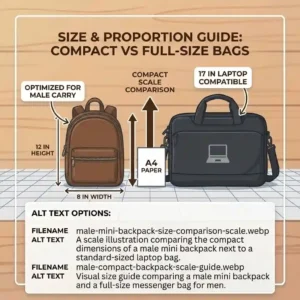
Traditional 25L-30L backpacks (like the classic JanSport or North Face Recon) are built for the “Just In Case” mindset. They allow you to carry your laptop, gym shoes, lunch, and a bulky hoodie all at once. However, the psychological effect of a large bag is that you will fill it. You end up carrying 15 pounds of items you rarely use, leading to chronic back strain and poor posture.
The compact male mini backpack operates on the “Just In Time” philosophy. It forces intentionality. You are restricted to a 10L volume, which physically prevents you from over-packing. The benefit here is immense agility. You can slide through turnstiles, sit in cramped cafe chairs without putting your bag on the dirty floor (it easily hangs on a chair back), and reduce your daily carry weight by 60%. If your daily routine doesn’t require a change of clothes or a massive laptop, sizing down is the smartest ergonomic choice you can make.
🛡️ Safety, Security, and Compliance Guide
When carrying high-value electronics in a small package, security becomes a paramount concern, especially in dense urban centers.
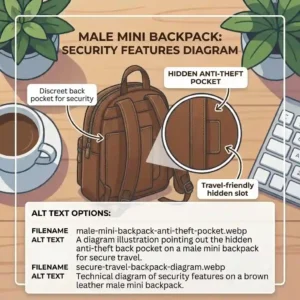
Because mini backpacks are so lightweight, it is shockingly easy for a pickpocket to unzip a smooth-gliding rear compartment on the subway without you feeling a shift in weight. To combat this, look for bags with “kissing zippers” (zipper pulls that interlock so a small padlock can be looped through them) or hidden stash pockets that sit flush against your lower back.
Furthermore, consider the visual footprint of the bag. Highly tactical bags covered in MOLLE webbing and velcro patches scream “expensive gear inside.” In my experience, a muted, minimalist bag in black, navy, or olive drab blends into the urban camouflage much better, drawing less attention from opportunists. If you travel internationally, ensure your chosen bag complies with airline “Personal Item” dimensions. Virtually all mini backpacks under 15L will safely fit under an economy class seat, saving you from rising overhead bin fees.
🧼 Long-Term Cost & Maintenance
A high-quality EDC bag should last you anywhere from 3 to 7 years if maintained properly. The “Total Cost of Ownership” for a $100 bag over 5 years is mere pennies a day, making it a highly justified investment compared to buying a $30 cheap bag that rips and needs replacing every 6 months.
Maintenance for these modern fabrics is straightforward but strictly counter-intuitive: never put your backpack in a washing machine. The agitation will destroy the internal polyurethane (PU) waterproof coatings and warp the foam padding.
Instead, practice a bi-annual deep clean. Fill a bathtub with lukewarm water and a gentle, non-detergent soap (like castile soap). Submerge the bag and use a soft-bristled brush to gently scrub the exterior panels. Rinse thoroughly and hang it upside down in a well-ventilated, shaded area. UV rays from direct sunlight will degrade synthetic nylon much faster than actual physical abrasion. If you notice your bag is starting to absorb rain rather than beading it off, you can reapply a DWR (Durable Water Repellent) spray for around $15, instantly reviving its weather resistance.
🏁 Conclusion
Transitioning to a male mini backpack is more than just a style choice; it is a commitment to a streamlined, efficient lifestyle. By stripping away the bulky excess of traditional daypacks, you are forcing yourself to carry only what matters, significantly reducing daily fatigue and improving your mobility.
Whether you opt for the rugged invincibility of the Carhartt Essentials, the tech-forward organization of the Tomtoc, or the featherweight packability of the Bellroy, the key is to match the bag’s materials and internal layout to your specific daily routine. Remember to prioritize high-quality zippers, comfortable back panels, and appropriate weather resistance over flashy aesthetics.
❓ FAQs
❓ What is the standard size for a male mini backpack?
✅ Typically, a mini backpack ranges from 7 to 15 liters in capacity. It is designed to hold everyday essentials like a tablet, a light jacket, keys, and a water bottle, bridging the gap between a pocket and a full-sized 30L daypack…
❓ Can a male mini backpack fit a laptop?
✅ Most true mini backpacks under 12L cannot fit a standard 13-inch or 15-inch laptop. They are perfectly sized for 10-inch or 11-inch tablets (like an iPad). Always check the exact internal dimensions before purchasing for tech…
❓ Is a sling bag considered a mini backpack?
✅ Yes, structurally and functionally, large sling bags (8L-12L) serve the exact same purpose as mini backpacks. They offer single-strap cross-body wear, which allows for quicker access to gear without completely removing the bag…
❓ Are mini backpacks acceptable for office environments?
✅ Absolutely. In 2026, minimalist, premium mini backpacks made from sleek materials like leather, ripstop, or matte nylon are highly acceptable in hybrid and casual corporate environments, looking much more professional than bulky, oversized hiking bags…
❓ How do I clean a nylon mini backpack?
✅ Never use a washing machine. Hand wash with lukewarm water and a mild soap using a soft brush. Hang dry out of direct sunlight to prevent UV degradation, and use a graphite pencil to lubricate stiff metal zippers…
📚 Recommended for You
- 5 Best Minimal Laptop Backpacks of 2026: Expert Tested and Reviewed
- Best EDC Bags for Men: 7 Top-Rated Picks for Everyday Carry in 2025
- 💥 The Ultimate Guide to Choosing the Best Coyote Backpack: 7 Expert-Analyzed Models for Every Mission!
Disclaimer: This article contains affiliate links. As an Amazon Associate, I earn from qualifying purchases. If you purchase products through these links, we may earn a small commission at no additional cost to you.
✨ Found this helpful? Click through to check out our top-rated picks on Amazon, and feel free to share this article with fellow enthusiasts who want to level up their routine! 💬🤗
