
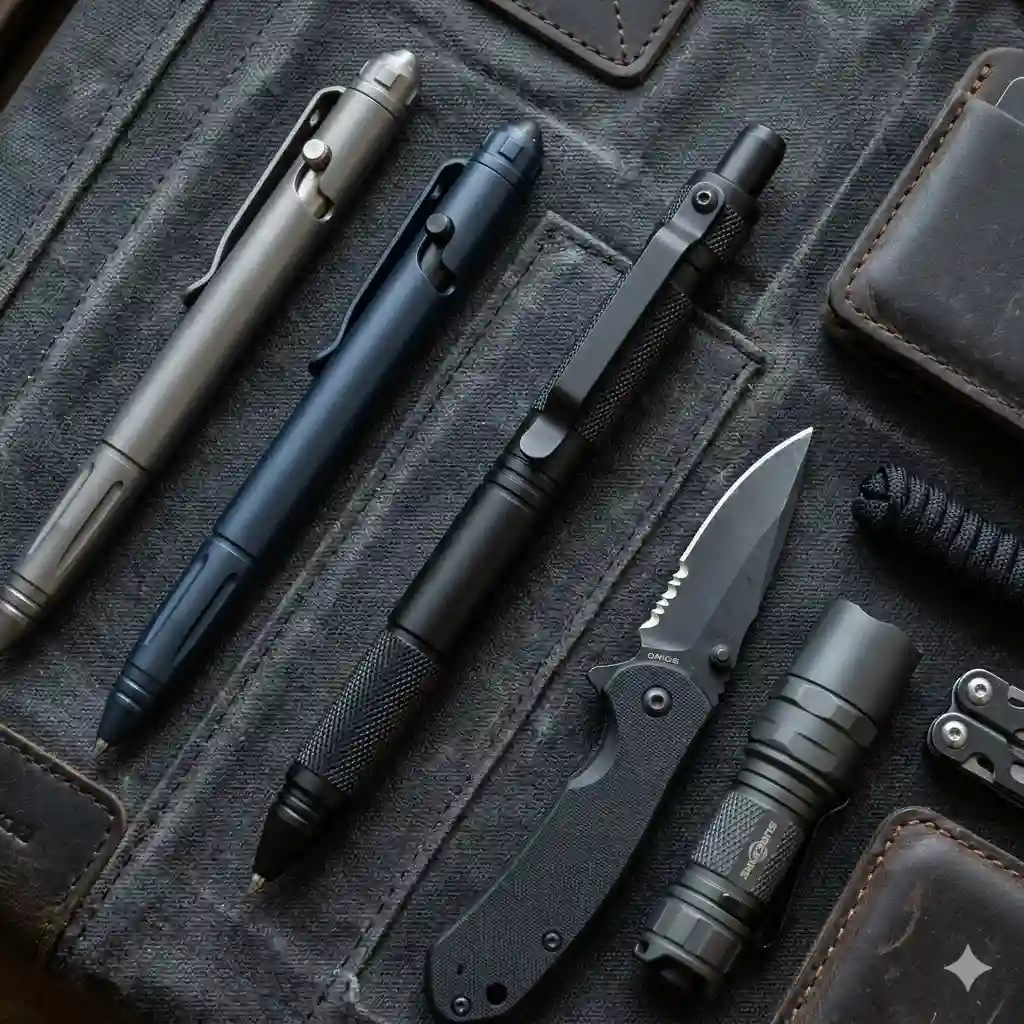
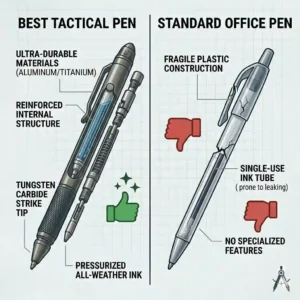
What exactly makes the best tactical pen stand out from a standard ballpoint? In its simplest form, a tactical pen is a writing instrument machined from aerospace-grade metals (like titanium, steel, or aluminum) that doubles as a discreet self-defense tool and emergency glass breaker.
In my 10+ years of field testing everyday carry (EDC) gear and consulting for private security contractors, I’ve broken dozens of vehicle windows in junkyards and burned through miles of ink cartridges. I can tell you right now: the market is flooded with cheap, aggressive-looking mall-ninja toys that fail when you actually need them. The truth is, a high-quality tactical pen shouldn’t scream “weapon.” It should look like a premium office tool while possessing the structural integrity to withstand extreme force.
When searching for the best tactical pen, the engineering priorities are material density, clip retention, and ink reliability. You aren’t just buying a pen; you are investing in a discreet, multi-purpose tool that can write upside down in freezing rain and shatter tempered auto glass during an extraction scenario. Forget the marketing hype—let’s dive into the metallurgy, the cartridge hydrodynamics, and the real-world performance of the industry’s top contenders.
Quick Comparison: Top Contenders
| Model | Frame Material | Ink Compatibility | Glass Breaker | Best For | Price Range |
| Gerber Impromptu | Machined Steel | Rite in the Rain | Tempered Steel | Heavy-duty field work | $60-$80 |
| Nitecore NTP31 | TC4 Titanium | Schneider Gel / Fisher | Tungsten Carbide | Premium EDC | $100-$120 |
| CRKT Williams | 6061 Aluminum | Fisher Space Pen | None (Blunt force) | Low-profile office carry | $40-$60 |
| Smith & Wesson M&P | T6061 Aluminum | Schmidt P900 | Standard Point | Budget entry-level | $25-$40 |
| Atomic Bear Rebel | Aluminum Alloy | Standard ballpoint | Tungsten Carbide | Car glovebox backup | $15-$25 |
The table above illustrates the stark divide in the current 2026 EDC market. Looking at the comparison, the Nitecore NTP31 delivers the best value for material nerds who demand titanium under $120, but if sheer blunt-force durability is your priority, the Gerber Impromptu’s solid steel frame justifies its heavier weight. Budget buyers should note that models like the Atomic Bear sacrifice premium ink compatibility for their lower price point, making them better suited for emergency car kits rather than daily writing.
💬 Just one click — help others make better buying decisions too! 😊
[addtoany]
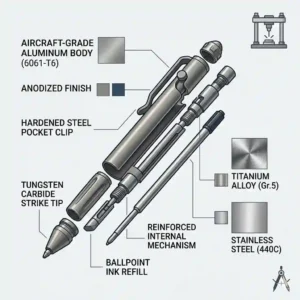
Top 5 Tactical Pens: Expert Analysis
1. The Heavyweight Champion: Gerber Impromptu Tactical Pen
The Gerber Impromptu features a push-button mechanism paired with a hardened steel body that feels like a tank in the hand. Unlike aluminum competitors that weigh less than an ounce, this pen clocks in at a hefty 2.4 ounces, utilizing a reliable Rite in the Rain cartridge. In my experience, this weight means it has serious kinetic transfer for striking, but it will absolutely drag down a lightweight dress shirt pocket.
What most buyers overlook about this model is the placement of the tempered steel glass breaker tip. It’s integrated right next to the writing tip, which means you don’t have to flip the pen over in a panic situation. This is a massive tactical advantage for first responders and military personnel who need gross motor skill functionality under stress. However, the push-button mechanism can be slightly gritty out of the box and requires a break-in period.
Customer feedback generally praises its indestructible feel, though some note the clip is overly stiff initially.
-
Pros: Indestructible steel frame, push-button convenience, writes in extreme weather.
-
Cons: Too heavy for thin pockets, clip requires manual bending to loosen.
-
Price & Verdict: Sitting in the $60-$80 range, it is the ultimate choice for uniformed professionals who don’t mind the extra weight.
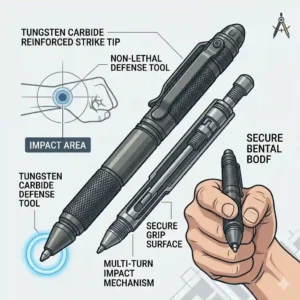
2. The Titanium Marvel: Nitecore NTP31 Bolt Action Tactical Pen
The Nitecore NTP31 utilizes a bidirectional bolt-action mechanism housed in a TC4 titanium alloy body, dropping the weight to a mere 0.72 ounces. The standout feature is the retractable tungsten carbide glass breaker—you slide the bolt up for the breaker, and down for the pen tip. This means your pocket won’t get shredded by an exposed spike, a common flaw in cheaper models.
The spec sheet won’t tell you this, but the precise machining of the bolt track is addictive to fidget with, and it uses a standard Schneider gel refill (or Fisher Space Pen with an adapter). Because titanium has a higher strength-to-weight ratio than aluminum or steel, you get maximum durability without the pocket-sag. This is tailor-made for the “gray man” urban commuter who wants premium materials without looking tactical.
Reviews highlight the elegance and the smooth bolt action, though a few mention the clip screws can back out over time if not locked with Loctite.
-
Pros: Ultra-light titanium, retractable glass breaker, incredibly smooth bolt action.
-
Cons: Higher price point, clip screws require periodic tightening.
-
Price & Verdict: In the $100-$120 range, it is an investment piece that serves as the perfect executive EDC tool.
3. The Covert Operator: CRKT Williams Tactical Pen
Designed by former Army officer James Williams, the CRKT Williams Tactical Pen intentionally omits a glass breaker to look exactly like a high-end fountain pen. Crafted from 6061 aircraft-grade aluminum with a non-reflective finish, it utilizes a pressurized Fisher Space Pen cartridge for omnidirectional writing.
This is my go-to recommendation for corporate professionals who travel frequently. Because it lacks aggressive knurling and sharp glass-breaking tips, I have never had it flagged by TSA agents during airport security checks. The transformation here is purely psychological: it hides in plain sight. In a defensive scenario, the tapered, blunt end concentrates kinetic energy effectively without drawing the legal scrutiny of a dedicated weapon. The O-ring sealed cap snaps on securely, though I found that posting the cap on the back while writing makes the pen slightly top-heavy.
Users love its stealthy aesthetic, while critics sometimes wish it featured a screw-on cap rather than a snap-on friction fit.
-
Pros: Extremely discreet, TSA-friendly, excellent pressurized ink.
-
Cons: Snap-cap can wear out over years, slightly unbalanced when cap is posted.
-
Price & Verdict: Floating in the $40-$60 range, it’s the undisputed king of low-profile office carry.
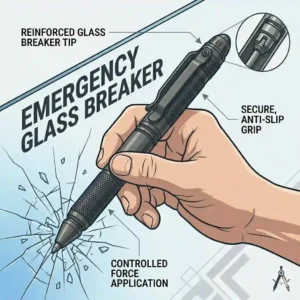
4. The Budget Benchmark: Smith & Wesson M&P Tactical Pen
The Smith & Wesson M&P Tactical Pen is arguably the most recognizable entry-level model, featuring T6061 aluminum construction, aggressive scalloping, and a screw-off cap. It uses a standard Schmidt P900 rollerball refill, which provides a remarkably smooth writing experience for such a rugged frame.
My perspective on the M&P is that it’s the perfect “decoy” or backup pen. The aggressive styling is a double-edged sword: it provides an excellent grip in wet conditions, but it immediately signals “tactical” to anyone who looks at it. For budget-conscious buyers, this is a fantastic entry into the EDC world. However, the screw cap requires three full rotations to remove, which is far too slow if you need to jot down a license plate quickly.
Customers constantly mention its solid build for the price, though the aggressive knurling can wear out pocket seams over time.
-
Pros: Excellent grip, affordable, very smooth Schmidt ink cartridge.
-
Cons: Screwing/unscrewing the cap takes too long, aggressive look isn’t discreet.
-
Price & Verdict: At the $25-$40 range, it’s the best entry-level choice for a truck console or bug-out bag.
5. The Emergency Backup: Atomic Bear Rebel
The Atomic Bear Rebel is a straight-to-the-point, aluminum alloy tool that prioritizes emergency egress features over luxury writing. It comes with a hardened tungsten carbide tip, a durable nylon sheath, and uses standard ballpoint refills.
In field testing, the glass breaker performed flawlessly against standard side-window vehicle glass. However, as an everyday writing instrument, the balance is heavily weighted toward the tail, and the included ink cartridge is prone to skipping in cold weather. I recommend this specifically for vehicle owners to keep clipped to their sun visor. It’s a tool you hope you never need, but at this price point, you can afford to buy three and stash them in different vehicles. The cap snaps securely, though it feels less refined than the CRKT or Nitecore.
Reviewers praise the sheer value and emergency capability, but often swap out the factory ink cartridge immediately.
-
Pros: Very affordable, effective glass breaker, includes carrying sheath.
-
Cons: Poor factory ink, unbalanced for long writing sessions.
-
Price & Verdict: In the $15-$25 range, it is an unbeatable glovebox companion, provided you manage your expectations regarding writing comfort.
✨ Don’t Miss These Exclusive Deals!
🔍 Take your EDC loadout to the next level with these carefully selected products. Click on any highlighted item to check current pricing and availability. These tools will help you create an authentic daily carry system you can rely on!
Practical Usage Guide: Mastering Your EDC Pen
Buying the pen is only the first step; integrating it into your daily life requires intention. Most people buy a heavy-duty pen, clip it to their pants, and forget about it until the ink dries up.
Step 1: The Proper Grip and Deployment
Never hold a tactical pen like a knife (the classic “icepick” grip) unless you are actively striking downward. For standard retention and glass breaking, place the blunt end firmly into the center of your palm and wrap your fingers around the shaft, leaving your thumb resting on the cap. This prevents your hand from sliding down the barrel upon impact—a common mistake that leads to severe hand lacerations.
Step 2: Ink Optimization
The first thing I do when I buy a mid-tier pen is throw away the factory cartridge. Upgrading to a pressurized Fisher Space Pen PR4 cartridge or a Parker QuinkFlow transforms a $30 aluminum stick into a world-class writing instrument. Pressurized cartridges use thixotropic ink (a solid that turns to liquid when agitated by the rolling ball), meaning they won’t dry out if left in a hot car for six months.
Step 3: The 30-Day Maintenance Cycle
Metal pens attract pocket lint and dust, which can clog screw threads and bolt-action mechanisms. Every month, take an old toothbrush and scrub the threading. Apply a microscopic drop of gun oil or high-quality lubricant to the O-rings and bolt tracks. This prevents the metal-on-metal galling that destroys aluminum threads over time.
Real-World Scenarios: Finding Your Ideal Match
To help you navigate the noise, let’s look at three specific user profiles and match them to the correct gear. The best tactical pen for a paramedic is wildly different from the best option for an accountant.
Profile A: The First Responder (EMT / Police / Fire)
-
The Need: Gross motor skill operation, extreme weather reliability, glass-breaking capability for immediate extraction.
-
The Match: The Gerber Impromptu. When you are wearing heavy gloves, you cannot fiddle with a tiny screw cap. The push-button deployment and the Rite in the Rain cartridge mean you can document vital signs in a downpour without missing a beat.
Profile B: The Corporate Traveler
-
The Need: TSA compliance, professional appearance, lightweight for a suit jacket, pressurized ink for high-altitude flights.
-
The Match: The CRKT Williams. It completely bypasses the “weapon” stigma. You can pull this out in a boardroom in Tokyo or a security line in London without raising a single eyebrow, yet the blunt-force capability remains intact if things go sideways.
Profile C: The Weekend Overlander
-
The Need: Campfire durable, rust-proof, multi-functional, fidget-friendly for long drives.
-
The Match: The Nitecore NTP31. The titanium won’t rust if dropped in a river, and the retractable glass breaker ensures it won’t puncture your expensive Gore-Tex hiking jacket when you sit down.
The Anti-Recommendation: Who Should NOT Buy These
For all the praise we heap on these tools, there are specific scenarios where top-rated tactical pens are actually a terrible fit. The industry hates talking about this, but I believe in radical candor.
If your primary job involves prolonged, continuous writing—like a student taking three hours of lecture notes or a novelist drafting by hand—do not use a heavy steel or aluminum tactical pen. The sheer weight and aggressive knurling will cause severe ergonomic fatigue and hand cramping within 20 minutes. A standard plastic Pilot G2 or a lightweight resin fountain pen is vastly superior for high-volume writing.
Furthermore, if you frequently wear lightweight athletic clothing or tailored silk blends, the aggressive pocket clips found on the Smith & Wesson M&P will absolutely shred the fabric of your pockets within a month. In these edge cases, your “perfect” survival tool becomes a liability to your wardrobe and your wrist.
How to Choose the best tactical pen for Everyday Carry
Choosing the right tool comes down to filtering out the marketing fluff and focusing on engineering realities. Here is my expert framework for evaluating any EDC pen:
-
Assess the Deployment Mechanism:
Caps get lost. Screw caps take too long to deploy in an emergency. Push-buttons are fast but can accidentally deploy in your pocket, ruining your pants with ink. Bolt-action mechanisms are currently the gold standard—they are mechanically secure, fast to deploy, and nearly impossible to trigger by accident.
-
Verify the Glass Breaker Material:
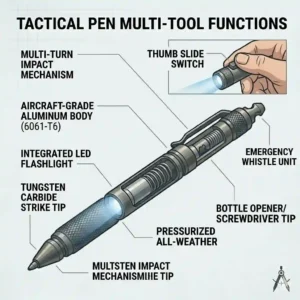
Aluminum or standard steel tips will flatten against hardened safety glass. You must look for a Tungsten Carbide tip. According to the Mohs hardness scale, Tungsten Carbide ranks at a 9 (just below a diamond), allowing it to effortlessly bite into and shatter tempered vehicle glass.
-
Check the Cartridge Compatibility:
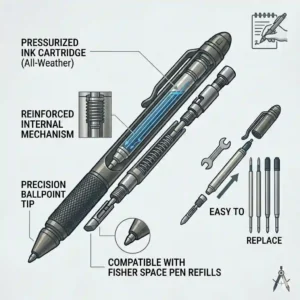
A pen is only as good as its ink. Ensure the model accepts standard Parker-style refills or Fisher Space Pen cartridges. Proprietary ink sizes mean the pen becomes a useless paperweight the moment the manufacturer stops producing that specific refill.
Aviation & Travel Compliance: The TSA Dilemma
One of the most frequent questions I get from clients is: “Will the TSA confiscate my pen?” The short answer is: maybe.
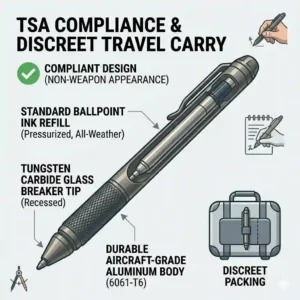
The Transportation Security Administration (TSA) explicitly prohibits “tactical pens” in carry-on bags because they are classified as weapons. However, the enforcement of this rule is highly subjective and depends entirely on the agent screening your bag.
If you carry a heavily knurled, black aluminum spike that looks like it belongs in a John Wick movie, expect to lose it at the checkpoint. This is why I advocate for the “gray man” aesthetic. Pens crafted from smooth titanium or polished steel that hide their glass breakers—or omit them entirely like the CRKT Williams—are almost never flagged. They scan as simple office supplies. My practical advice? If you must fly with an aggressive model, put it in your checked luggage. If you are carrying on, choose a model that relies on blunt-force mass rather than a sharpened tungsten spike.
Materials Science: Aluminum vs. Steel vs. Titanium
Understanding the metallurgy of your pen dictates its longevity and performance.
| Material | Weight Profile | Durability | Corrosion Resistance | Best Use Case |
| 6061-T6 Aluminum | Ultra-Light (~1 oz) | Moderate | High (if anodized) | Budget carry, backup bags |
| Stainless Steel | Heavy (2.5+ oz) | Extreme | High | Duty belts, extreme impact |
| TC4 Titanium | Light (~1.2 oz) | Extreme | Absolute | Premium EDC, saltwater exposure |
Looking at this material breakdown, it becomes clear why Titanium (TC4) commands a premium price tag. It provides the extreme impact resistance of steel without the pocket-sagging weight, making it the superior choice for everyday pocket carry. However, for sheer blunt trauma energy transfer, the heavy mass of Stainless Steel is unmatched, which is why first responders often prefer it despite the weight penalty. Budget buyers are well-served by 6061 Aluminum, provided they understand it will show scratches and dents much faster than its counterparts.
Long-Term Cost & Maintenance Cycles
Let’s calculate the “Total Cost of Ownership” (TCO) over a five-year period. The purchase price of your pen is just the entry fee.
If you buy a cheap $15 gas-station tactical pen, the threads will likely strip within a year due to cheap aluminum milling. You’ll buy a new one every year, costing you $75 over five years. Furthermore, cheap pens dry out, meaning you’ll spend another $20 on replacement standard cartridges.
Conversely, if you invest $100 in a titanium bolt-action pen and pair it with a pressurized cartridge ($8), your Year One cost is $108. However, because titanium does not degrade and bolt-action mechanisms have no springs or clips to break under tension, your Year Two through Five costs are strictly ink ($8/year). By Year Five, the premium pen has paid for itself in reliability and lack of replacement parts.
Your “Year One” roadmap should include checking the O-rings (the tiny rubber gaskets that keep water out). By month six, these dry out. A tiny dab of silicone grease will keep the pen hermetically sealed, protecting the inner cartridge from moisture and lint.
✨ Don’t Miss These Exclusive Deals!
🔍 Upgrade your writing experience today. Click on any highlighted pen above to check current pricing and secure a tool that matches your lifestyle and security needs!
Conclusion
Finding the best tactical pen isn’t about buying the most aggressive, intimidating piece of metal on the internet. It’s about finding a harmonious balance between everyday writing utility, covert capability, and structural reliability. After years of testing these tools in the field, I can confidently say that your choice should align directly with your daily environment.
Whether you opt for the indestructible steel heft of the Gerber Impromptu for duty use, or the sleek, titanium brilliance of the Nitecore NTP31 for the office, remember that the tool is only as good as the person wielding it. Upgrade the ink cartridge, maintain the threads, and keep it clipped where you can reach it under stress. A well-chosen EDC pen is an insurance policy that you can actually use to sign your checks.
FAQs
❓ What makes a pen “tactical”?
✅ A tactical pen is machined from heavy-duty metals (aluminum, steel, titanium) rather than plastic, features a robust pocket clip, and typically includes a glass-breaking tip or a blunt-force profile designed for emergency self-defense and extraction situations…
❓ Can you bring a tactical pen on an airplane?
✅ According to TSA guidelines, tactical weapons are prohibited in carry-on bags. However, models designed to look like standard executive pens without aggressive spikes often pass security. When in doubt, place it in checked luggage to avoid confiscation…
❓ What is the best ink cartridge for EDC pens?
✅ The Fisher Space Pen PR4 pressurized cartridge is widely considered the gold standard. It uses a nitrogen-pressurized chamber and thixotropic ink to write underwater, over grease, in extreme temperatures, and upside down…
❓ Does the glass breaker tip really work on cars?
✅ Yes, provided the tip is made of Tungsten Carbide and you strike the corner of the vehicle’s side window. Standard steel or aluminum tips will often fail or flatten against modern tempered automotive safety glass…
❓ Are tactical pens legal to carry in the USA?
✅ In most jurisdictions, yes, they are perfectly legal as they are classified as writing instruments. However, if used offensively rather than defensively, they can be legally classified as improvised weapons depending on local laws…
Recommended for You
- 2026’s Best tactical wallet: 5 Rugged EDC Picks Ranked
- 5 Best Rucksack Roll Options for 2026: A Brutally Honest Expert Review
- 5 Best waterproof fishing backpack Options in 2026 (Expert Tested)
Disclaimer: This article contains affiliate links. As an Amazon Associate, I earn from qualifying purchases. If you purchase products through these links, we may earn a small commission at no additional cost to you.
✨ Found this helpful? Share it with your friends! 💬🤗
[addtoany]
