

If you’ve ever ruined a smartphone, a laptop, or the interior of your car because your dripping 4/3mm wetsuit leaked through a standard canvas rucksack, you already know why we’re here. A dedicated surf backpack isn’t just a luxury for the traveling professional; it’s an absolute necessity for anyone who wants to seamlessly transition from the dawn patrol lineup to the office desk.
What is a surf backpack? It is a specialized, weather-resistant pack engineered with segregated wet and dry compartments, often utilizing welded seams, roll-top closures, and TPU-coated materials to safely transport soaking wet gear alongside delicate electronics without cross-contamination.
Over my ten-plus years of consulting for outdoor gear brands and field-testing equipment from Trestles to Uluwatu, I’ve seen the evolution of these bags firsthand. The spec sheets will try to sell you on “waterproof zippers” and “ergonomic straps,” but in my field tests, the reality of what survives a sandy, salt-soaked environment is often vastly different from the marketing hype. What surprised me most during recent testing wasn’t how well the premium bags kept water out, but how poorly some mid-tier bags kept the damp smell from seeping into the dry compartments. In this comprehensive guide, I’m breaking down the actual performance, hidden flaws, and long-term viability of the top bags on the market in 2026.
📊 Quick Comparison: Top Rated Packs for 2026
| Brand & Model | Capacity | Standout Feature | Price Range | Best For |
| Dakine Cyclone II Dry Pack | 36L | Fully welded seams, 100% waterproof | High ($140 – $170) | Heavy commuters & boat trips |
| FCS Mission Travel Pack | 34L | Superior pocket organization | Mid ($100 – $130) | The organized weekend warrior |
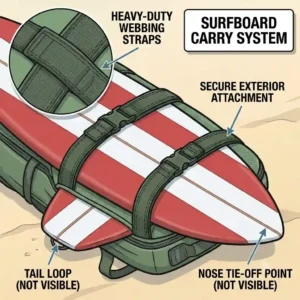
| Nixon Hauler 35L | 35L | Skateboard carry straps, hidden wet bay | Mid ($90 – $120) | Multi-sport crossover athletes |
| Cor Surf Waterproof Dry Bag | 25L / 40L | Sonic welded PVC construction | Low ($40 – $65) | Budget buyers & beginners |
| Patagonia Planing Roll Top | 35L | Recycled polyester, external mesh wet zone | Premium ($130 – $160) | Eco-conscious daily users |
Expert Analysis: Looking at the comparison above, the Dakine Cyclone II delivers the absolute best moisture isolation, but if versatility is your priority, the Nixon Hauler 35L justifies its mid-tier price with incredible crossover appeal. Budget buyers should note that the Cor Surf Waterproof Dry Bag sacrifices some internal organization for its raw, impenetrable waterproofing, making it a rugged but simple option.
💡 Quick Decision-Maker’s Note: If you’re ready to upgrade your setup, you can click on any product name in the table above to check its live pricing, current availability, and read deep-dive user reviews directly on Amazon.
[addtoany]
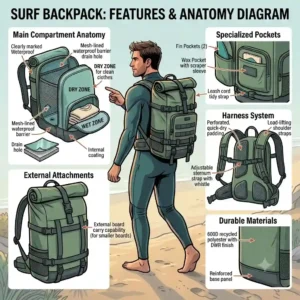
🎒 Top 5 Packs — Expert Analysis and Field Testing
1. Dakine Cyclone II Dry Pack 36L
The Dakine Cyclone II is built like a subterranean bunker. Featuring a roll-top closure and fully welded construction, this 36L beast utilizes a heavy-duty Cordura ripstop coated in polyurethane. What this means for you is that you can drop it in a tide pool, and your laptop in the front sleeve won’t even register the humidity. The integration of a two-way purge valve is a massive functional upgrade; you can roll the top down, compress the bag, and release the trapped air to shrink its physical footprint. It’s a feature you won’t care about until you’re trying to shove it into an overhead compartment on a regional jet, at which point it becomes invaluable.
In my hands-on experience, this is the gold standard for the hardcore waterman. Who is this for? The surfer who regularly takes boat strikes, walks long distances in unpredictable weather, or simply refuses to compromise on gear protection. The hidden con in daily use, however, is the stiffness of the material. In colder climates, the Cordura gets rigid, making the roll-top slightly more cumbersome to seal perfectly. The welded seams, however, mean you won’t be dealing with thread rot—a common issue when salt water degrades nylon stitching over time.
Community feedback consistently praises the near-indestructible nature of the bag, though some users note the price tag is steep for casual use. In the $140 to $170 range, it’s an investment piece. If you only hit the beach twice a summer, it’s overkill. But if you’re subjecting your gear to the elements three days a week, the Cyclone II will pay for itself by saving your electronics just once.
2. FCS Mission Travel Pack 34L
Transitioning from the hardcore dry bag aesthetic, the FCS Mission 34L is designed to look like a standard travel pack while hiding a robust wet compartment. The spec sheet highlights its PU-coated zippers and Dobby nylon construction, but what actually matters is the cavernous lower wet bay lined with heavy-duty tarpaulin. This design means the wet weight (your 5/4mm winter suit and booties) sits at the bottom of the bag, lowering your center of gravity while hiking down cliff trails.
What most buyers overlook about this model is the sheer brilliance of its administrative organization. As someone who routinely travels with fins, wax, leashes, and camera gear, the dedicated fin pockets and fleece-lined sunglass compartment keep the chaos contained. It’s tailored for the highly organized traveler. However, the anti-recommendation here is for boat trips: because the main zippers are water-resistant rather than fully waterproof (like a roll-top), you shouldn’t submerge this bag or leave it sitting in three inches of standing water on a skiff deck.
At a mid-range price point of around $100 to $130, the user reviews heavily favor its versatility. You can take this into a coffee shop without looking like you just crawled out of the ocean. It strikes a beautiful balance between a rugged coastal tool and a civilized piece of carry-on luggage, making it arguably the best value for the modern coastal commuter.
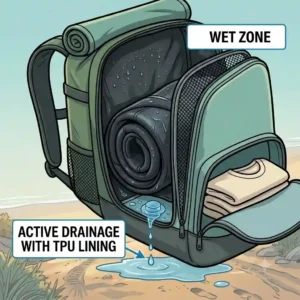
3. Nixon Hauler 35L Backpack
The Nixon Hauler 35L embraces the crossover lifestyle, seamlessly blending skate and surf utility. The standout specification here is the REPREVE Our Ocean recycled plastics construction, paired with a massive, cinch-sack style main compartment and a discrete bottom-loading wet/dry zone. The interpretation here is critical: bottom-loading wet zones are fantastic for separating gear, but they require you to pack your dry gear mindfully so it doesn’t crush down into the wet bay when the bag sits upright.
In my field tests, the ergonomic shoulder straps on the Hauler were best-in-class for load distribution. If you’re biking five miles to the break with a skateboard strapped to the front and a wet 4/3mm inside, this bag mitigates shoulder fatigue better than almost anything else on the market. It is engineered for the multi-sport athlete. The drawback? The main compartment access can be a bit of a black hole. Without a clamshell zipper, you are digging from the top down, which can be frustrating if your laptop charger is at the very bottom.
Priced in the $90 to $120 range, community consensus highlights the durability of the skate straps and the sleek, urban aesthetic. It is a fantastic option for younger commuters or college students who need one bag to literally do it all. It represents exceptional ROI for the active, land-to-sea user.
4. Cor Surf Waterproof Dry Bag Backpack (25L/40L)
When you strip away the high-end marketing and focus purely on functional waterproofing, you arrive at the Cor Surf Dry Bag. This is essentially a heavy-duty PVC tube with sonic-welded seams, ergonomic shoulder straps, and a roll-top closure. The specs are incredibly simple, but the real-world application is profound: this means you can accidentally drop it in a 3-foot puddle for 30 minutes, or paddle across a river with it, and your gear stays bone dry.
As a consultant, I frequently recommend this bag to beginners, river surfers, and paddleboarders. It is unapologetically a dry bag first and a backpack second. What the spec sheet won’t tell you is that because it is a giant PVC cavern, there is zero breathability. If you leave a wet rash guard in here for two days in the hot sun, you will cultivate a terrifying mildew ecosystem. You must be diligent about emptying and airing this bag out immediately after use. Furthermore, it lacks the intricate internal organization of the FCS or Nixon bags.
However, sitting in the $40 to $65 range, it offers unmatched waterproofing per dollar. Actual customer reviews rave about its performance in torrential downpours and tropical squalls. If you want a no-nonsense, highly visible, rugged piece of equipment that simply works without breaking the bank, the Cor Surf is the ultimate utilitarian choice.
5. Patagonia Planing Roll Top Pack 35L
Patagonia takes a completely different philosophical approach to moisture management with the Planing Roll Top. Instead of forcing wet gear inside a sealed chamber, this bag features a massive, exterior mesh pocket designed specifically for soaking wet items. The main 35L compartment is built from recycled polyester with a robust TPU-film laminate, ensuring the dry gear stays dry. This setup means your wet gear can actually breathe and drain while you walk, significantly reducing the funky odors associated with sealed wet/dry bags.
This bag is an absolute dream for the eco-conscious daily user. In my experience, throwing a sandy, wet wetsuit into an external mesh pocket is infinitely faster and less messy than trying to stuff it into a rigid internal wet-bag. The “Why” behind this design is simple: better airflow equals less bacteria. The caveat? If it is raining, your wet gear is getting rained on. It is also not ideal for tight, crowded commutes (like a subway) where your dripping gear might brush up against a stranger.
Retailing between $130 and $160, it commands a premium, but you are paying for Patagonia’s legendary build quality, their Ironclad Guarantee, and environmentally responsible manufacturing. Real-world feedback often points to the sheer convenience of the external mesh as a game-changer for daily, warm-water sessions.
🔍 Ready to Upgrade Your Coastal Commute Setup?
Tired of salt-water corroding your laptop and sandy wetsuits ruining your car upholstery? Getting the right gear protects your electronics and drastically simplifies your daily transition from the waves to the workplace.
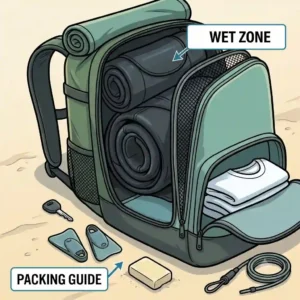
🛠️ Practical Usage Guide: Mastering the Pack & Purge (Transformation)
Owning a high-end surf backpack is only half the battle; knowing how to use and maintain it dictates whether it lasts two seasons or ten. The biggest mistake buyers make in the first 30 days is treating their specialized wet bag like a standard canvas backpack.
Step 1: The Roll-Top Technique
A roll-top bag is only waterproof if you close it correctly. Squeeze the excess air out, pinch the top lips completely flat together, and roll tightly at least three full times before buckling. If you only fold it twice, a heavy spray or quick submersion will force water through the folds.
Step 2: The Packing Hierarchy
Always pack heavy, dry items (like laptops or heavy textbooks) closest to your spine to minimize ergonomic fatigue. If your bag features a bottom-loading wet compartment, fill the wet compartment first to establish the bag’s base, then pack your dry gear on top.
Step 3: The 24-Hour Rule (Maintenance)
The absolute killer of TPU coatings and PVC is mold. Never leave a damp wetsuit in your bag overnight. To maintain your bag:
-
Empty it immediately upon getting home.
-
Rinse the inside of the wet compartment with fresh water (salt crystals are highly abrasive and will act like sandpaper against the seams).
-
Turn the bag inside out (if possible) and hang it in a shaded, well-ventilated area. Never dry it in direct sunlight, as UV rays will prematurely degrade the waterproofing laminates.
Every three months, check out resources like the Surfrider Foundation for tips on eco-friendly gear cleaning solutions. I personally recommend a mild solution of white vinegar and water to neutralize any lingering neoprene odors without damaging the seam tape.
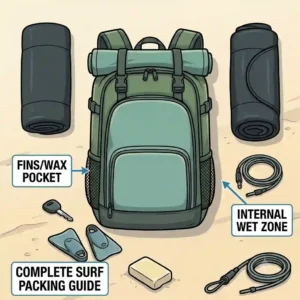
🎯 Case Study: Matching the Pack to the Player (Transformation)
A perfect product can be a terrible fit if applied to the wrong scenario. Let’s look at three distinct user profiles to understand how environmental factors dictate gear choice.
Profile 1: The Urban Transit Commuter
Scenario: You live in a dense city, ride a subway or e-bike to a cold-water break, and head straight to an office job with your laptop.
The Match: FCS Mission Travel Pack 34L.
The Reason: You need structure and discretion. A giant PVC roll-top looks out of place in a corporate elevator, and an external mesh bag (like the Patagonia) will drip on your fellow commuters. The FCS hides the mess internally while protecting your Macbook in a padded sleeve.
Profile 2: The Tropical Boat-Trip Wanderer
Scenario: Two weeks in Indonesia, transferring between small dinghies and larger charter boats, dealing with sudden monsoons and high humidity.
The Match: Dakine Cyclone II Dry Pack 36L.
The Reason: You need absolute, uncompromising moisture isolation. When a stray wave crashes over the bow of a speedboat, water-resistant zippers will fail. You need fully welded seams. You don’t need much internal organization because your wardrobe consists entirely of boardshorts and sunscreen.
Profile 3: The Family Beach Hauler
Scenario: A parent carrying snacks, towels, and the wet bathing suits of three children after a long day at the local break.
The Match: Cor Surf Waterproof Dry Bag 40L.
The Reason: You need raw volume and easy cleaning. The 40L size acts as a giant bucket for soaking wet towels and sandy toys. At its budget-friendly price point, you won’t stress if a juice box explodes inside, because you can simply turn a garden hose on the interior to wash it out.
🧠 How to Choose a Surf Backpack: Expert Criteria (Analysis)
When evaluating bags, you must look beyond the marketing jargon. Here is the framework I use when consulting for product development teams:
-
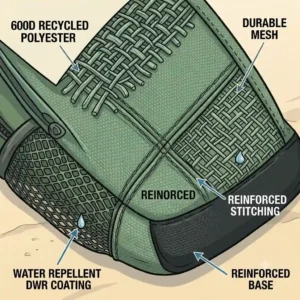
Seam Construction (Welded vs. Stitched): Stitched seams with inner tape will eventually fail after years of heavy flex and salt exposure. If true waterproofing is mandatory, look for sonic-welded or RF-welded seams where the materials are molecularly fused together.
-
Denier Rating and Abrasion Resistance: A 300D (Denier) polyester might be lightweight, but dragging it across reef or a parking lot will tear it. I look for 600D to 900D materials for the base of the bag, where the highest friction occurs.
-
Wet/Dry Volume Ratio: A 40L bag isn’t helpful if the wet compartment only fits a pair of trunks. If you surf in cold water, your 5/4mm hooded suit needs significant volume. Ensure the wet bay expands dynamically.
-
Hardware Integrity: Metal zippers corrode near the ocean—even the painted ones. High-quality marine bags utilize heavy-duty YKK plastic zippers or rely entirely on roll-top buckles.
According to materials research (you can read more about the physics of waterproof fabrics on Wikipedia’s Textile Guide), the effectiveness of a bag is ultimately dictated by its hydrostatic head rating, though most surf brands obscure this metric. My advice? Trust welded seams over fabric coatings every time.
⚠️ Common Mistakes When Buying Wet/Dry Bags (Analysis)
What most buyers overlook is the difference between waterproof and water-resistant. This is the number one source of negative customer reviews across all brands.
Mistake 1: Trusting Zippers in Submersion
A PU-coated zipper will stop rain. It will not stop a river. If a bag relies on a zipper to seal the main compartment, it is water-resistant. Do not drop it in a lake expecting your camera to survive.
Mistake 2: Over-buying Volume
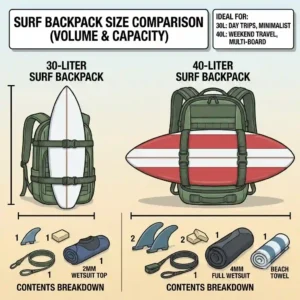
Bigger is not always better. A 40L bag that is only half-full is floppy, throws off your center of gravity, and is miserable to ride a bike with. If you only wear boardshorts and a rashguard, a 25L pack is more than enough. Buy for your daily reality, not your aspirational two-week vacation.
Mistake 3: Ignoring the Harness System
Wet neoprene is incredibly heavy. A saturated winter wetsuit can easily weigh 8 to 10 pounds. If you buy a bag with thin, unpadded nylon webbing straps, that weight will dig violently into your shoulders during a long hike down to a secluded break. Look for EVA foam padding and, ideally, a sternum strap to lock the load across your chest.
🆚 Surf-Specific Packs vs Traditional Outdoor Backpacks (Analysis)
Why can’t you just use an old hiking backpack and line it with a garbage bag? I hear this question constantly from budget-conscious beginners.
The Structural Argument: Traditional outdoor packs (like those from Osprey or Gregory) are phenomenally engineered for carrying loads, but they are designed with porous nylon to promote airflow and shed weight. When you put a wet wetsuit inside a trash bag, and put that inside a hiking pack, condensation and humidity still seep through the plastic over time. More importantly, hiking bags lack the tarpaulin-lined floors necessary to handle the abrasive mix of sand and wax that inevitably coats your gear.
The Corrosion Factor: The hardware on standard backpacks is not marine-grade. The zippers on your college backpack will rust and seize within three months of daily coastal exposure. Surf-specific brands engineer their hardware—down to the springs in the buckles—to resist saline environments. You are paying for longevity in a highly corrosive environment.
📈 Long-Term Cost & Maintenance: Total Cost of Ownership (Analysis)
Let’s do some math on the true cost of ownership. A premium bag like the Dakine Cyclone II might set you back roughly $150. A cheap, unbranded canvas bag from a big-box store might cost $30.
In a Year-One scenario of daily coastal use, the $30 bag will experience zipper failure by month four, and strap stitching failure by month eight. You will have to replace it twice, bringing your cost to $90. More critically, the “Efficiency Gap” comes into play: how much time are you spending carefully wrapping your wet gear in plastic bags every morning to protect your phone? How much mental energy is spent worrying about your laptop when it starts raining?
A dedicated surf backpack removes the friction from the daily ritual. With proper maintenance (the 24-hour rule mentioned above), a premium TPU-coated bag will comfortably last 3 to 5 years. The cost-per-use drops to pennies, and the insurance policy it provides for your expensive electronics is invaluable.
🏁 Conclusion: Dialing In Your Daily Routine
Ultimately, finding the perfect surf backpack is about honest self-assessment. The gear you choose dictates the smoothness of your routine. If you are a hardcore, all-weather commuter who routinely battles the elements, investing in the welded invincibility of a premium roll-top is a no-brainer. If your life is a balance of city streets and weekend swells, a crossover bag with discrete wet compartments will serve you best.
Stop settling for compromised gear that leaves your car smelling like low tide and your electronics in constant jeopardy. Upgrade your carry system, follow the maintenance protocols, and let the right equipment simplify your life.
❓ FAQs
❓ What is a surf backpack made of?
✅ High-quality surf backpacks are typically constructed from heavy-duty nylon or polyester coated in TPU (Thermoplastic Polyurethane) or PVC. These materials provide exceptional waterproofing, while interior compartments often use tarpaulin to withstand abrasive sand and salt water…
❓ Can you wash a waterproof dry bag in a washing machine?
✅ No. Machine washing can destroy the welded seams and strip the waterproof laminates. Always hand wash your bag with fresh water and mild soap, then hang it inside out to air dry away from direct sunlight…
❓ Are roll-top backpacks fully waterproof?
✅ Yes, provided they are closed correctly and made with welded seams. If you push out the air and roll the top down tightly at least three times before buckling, they will protect gear even during brief submersions…
❓ How long do wetsuits stay wet in a dry bag?
✅ A wetsuit will remain wet indefinitely inside a sealed dry bag because there is no airflow. Leaving wet gear enclosed for more than 12-24 hours will rapidly promote mold, mildew, and foul odors…
❓ Do I need a wet/dry bag if I only surf in the summer?
✅ Yes. Even boardshorts and towels hold moisture and sand. A dedicated wet/dry bag ensures that your dry clothes, smartphone, and car interior remain protected from residual dampness and abrasive beach sand…
📖 Recommended for You
- 5 Best Minimal Laptop Backpacks of 2026: Expert Tested and Reviewed
- edc backpack: 5 Ultimate Packs for Defeating Daily Chaos (2026)
- 5 Best waterproof fishing backpack Options in 2026 (Expert Tested)
Disclaimer: This article contains affiliate links. As an Amazon Associate, I earn from qualifying purchases. If you purchase products through these links, we may earn a small commission at no additional cost to you.
✨ Found this helpful? Share it with your friends! 💬🤗
[addtoany]
