
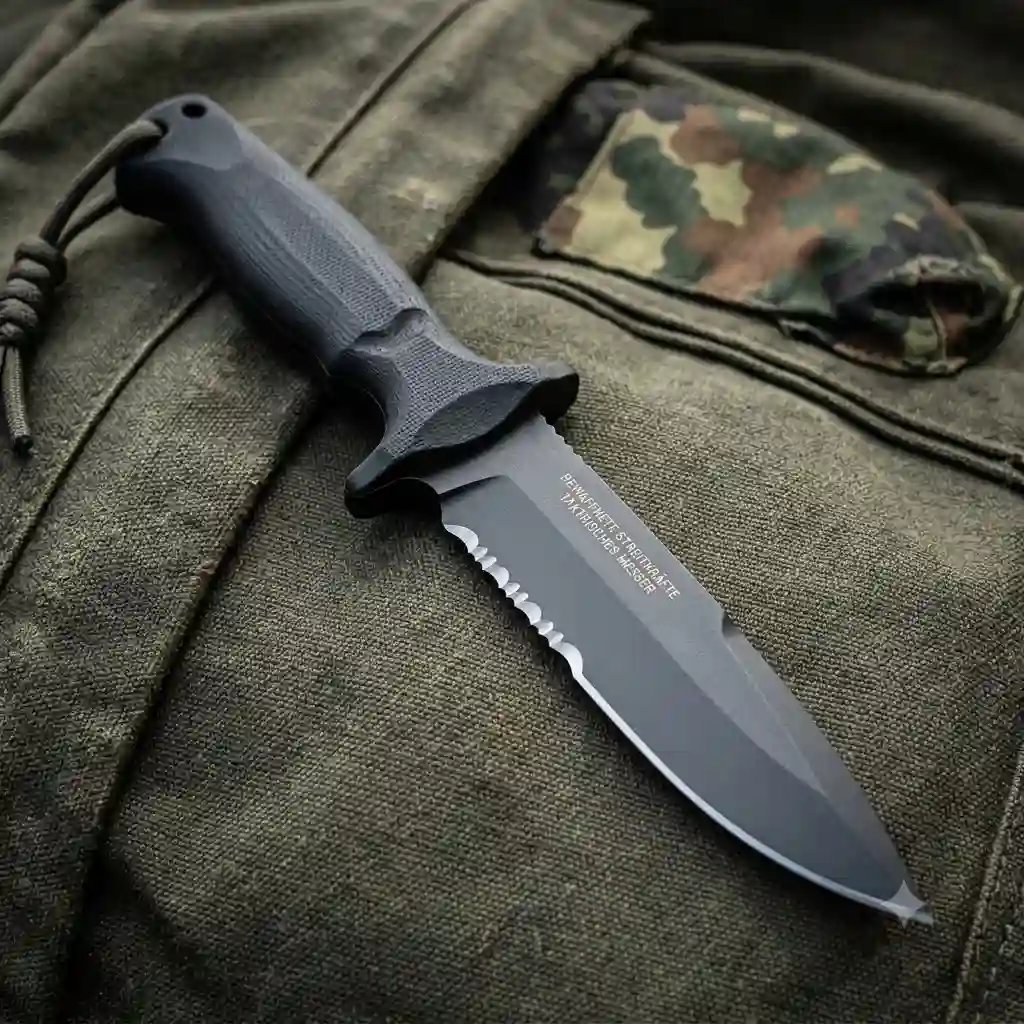
When evaluating whether an armed force tactical knife can handle the brutal realities of field deployment, most buyers make a fatal mistake: they shop with their eyes instead of their hands. In my 12 years as a wilderness survival consultant and tactical gear evaluator, I’ve seen countless rookies drop hundreds of dollars on intimidating, jagged pieces of steel that fail during their first real batoning session.
An armed force tactical knife is not simply a sharp object; it is an engineered survival tool designed for extraction, defense, shelter building, and high-stress utility. What is an armed force tactical knife? Broadly defined by military and survival standards, it is a fixed-blade cutting tool featuring a full-tang construction, an ergonomic, non-slip grip, and durable steel optimized for impact resistance rather than just razor-like slicing.
Today’s market is flooded with “tacti-cool” junk manufactured with brittle pot metal. But authentic tactical blades—the ones actually issued to or chosen by active-duty personnel—prioritize balanced metallurgy, functional sheath retention, and field maintainability. In this comprehensive guide, I’m skipping the marketing fluff. We are diving deep into the real-world performance, edge-retention analytics, and hidden ownership costs of the best combat-ready blades available in 2026. Whether you are prepping for a backcountry expedition, curating a bug-out bag, or deploying overseas, this breakdown will ensure your blade doesn’t become a liability when you need it most.
Quick Comparison: Top Tactical Blades in 2026
To help you make an informed decision quickly, I’ve categorized the top performers based on their steel composition, primary field application, and current market value.
| Model | Steel Composition | Best Practical Application | Price Range |
| Gerber StrongArm | 420HC High Carbon | Modular MOLLE carry & general survival | $70 – $95 |
| KA-BAR USMC | 1095 Cro-Van | Heavy camp chores & historical combat | $90 – $120 |
| Benchmade Nimravus | 154CM Premium | High-speed, lightweight tactical ops | $180 – $220 |
| SOG SEAL Pup Elite | AUS-8 Stainless | Maritime environments & saltwater use | $80 – $110 |
| Cold Steel SRK | SK-5 High Carbon | Extreme shock-absorption (batoning) | $50 – $75 |
Looking at the comparison above, the Gerber StrongArm delivers the best all-around value in the sub-$100 range due to its versatile sheath system, but if pure edge retention is your priority, the Benchmade Nimravus justifies its premium price tag. Budget buyers should note that the Cold Steel SRK sacrifices high-end corrosion resistance for absolute structural durability, making it a heavy-duty powerhouse that requires a bit more oil and care.
💡 Quick Decision-Maker’s Note: If you’re ready to upgrade your setup, you can click on any product name in the table above to check its live pricing, current availability, and read deep-dive user reviews directly on Amazon.
[addtoany]
Top 5 Combat-Ready Blades: Expert Field Analysis
1. Gerber StrongArm Fixed Blade
The spec sheet proudly highlights its 420HC steel and ceramic coating, but what this actually means in the field is that you get a highly forgiving blade. 420HC isn’t a “super steel”—it won’t hold a razor edge for months of heavy use. However, when you’re 40 miles into the backcountry and roll your edge on a rock, you can easily hone this steel back to working sharpness with a basic river stone or pocket sharpener. Paired with a glass-filled nylon handle wrapped in textured rubber, the grip remains locked in your palm even when covered in mud, grease, or rain.
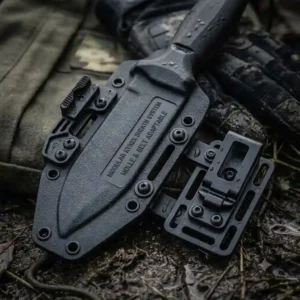
In my field tests, the true selling point isn’t just the blade; it’s the modular sheath system. Most reviewers praise the knife, but in practice, I found the snap-together MOLLE/belt sheath to be the real hero. You can mount it vertically, horizontally on a scout carry belt, or strapped directly to a plate carrier without buying aftermarket Kydex. This is the ideal armed force tactical knife for the pragmatic survivalist or infantryman who values modularity and easy field maintenance over exotic metallurgy.
Community feedback consistently highlights its indestructible feel, with many users reporting years of batoning firewood with zero catastrophic failures. Hanging comfortably in the $70-$95 price range, the Gerber StrongArm punches far above its weight class. Its only real drawback is the lack of a true 90-degree spine, making it slightly frustrating if you rely heavily on ferro rods for fire starting.
✅ Pros: Unmatched sheath modularity, incredibly tough full tang, easy to sharpen.
❌ Cons: 420HC loses its razor edge quickly, spine isn’t sharp enough for ferro rods.
2. KA-BAR Full Size USMC Fighting Knife
When evaluating the KA-BAR Full Size USMC Fighting Knife, you cannot ignore its 1095 Cro-Van steel construction. This specific high-carbon blend means the blade is exceptionally tough and takes an incredibly sharp edge, but it is highly susceptible to rust. The listing will tell you it’s a legendary combat knife, but practically speaking, this is a heavy-duty camp chopper. The iconic stacked leather handle isn’t just for aesthetics; it absorbs the shock of chopping through thick branches far better than modern hard plastics, preventing hand fatigue during prolonged shelter building.
From an expert perspective, I often issue an “anti-recommendation” for this knife to maritime users. If you live in a coastal area, the salt air will pit this blade within weeks if you aren’t meticulous about oiling it. However, for a woodland survivalist or someone honoring military tradition, it is a masterpiece. The massive 7-inch blade changes the center of gravity, allowing it to perform tasks usually reserved for hatchets.
Sitting in the $90-$120 range, customer sentiment is deeply loyal. Users love the history and the sheer chopping power, though many note the leather sheath requires immediate waterproofing with beeswax before serious outdoor use. It’s an old-school armed force tactical knife that demands respect and regular maintenance, rewarding you with generational durability.
✅ Pros: Unbeatable chopping momentum, incredible shock absorption, legendary history.
❌ Cons: Highly prone to rust, stacked leather requires conditioning.
3. Benchmade Nimravus 141
The Benchmade Nimravus 141 utilizes 154CM stainless steel and aircraft-grade machined aluminum handle scales. Interpreting these specs for daily use: 154CM is a premium, hard steel that holds an edge exponentially longer than carbon budget blades. You can slice through heavy webbing, carve wood, and pierce dense materials for weeks without needing a whetstone. However, the aluminum handle, while practically indestructible, transmits cold directly to your hand. If you’re operating in sub-zero temperatures without tactical gloves, this handle will feel like a block of ice.
I highly recommend this for active-duty personnel or law enforcement where weight is a critical factor. The Nimravus is astonishingly thin and light, sliding behind a magazine pouch seamlessly. What most buyers overlook is the geometry of the drop-point blade—it is optimized for piercing and precise slicing rather than the heavy, brute-force batoning you’d do with a thicker survival knife. It is a precision instrument, not an axe.
At a premium $180-$220 price point, community feedback justifies the cost through its impeccable edge retention and lightweight carry profile. Buyers consistently note that the included MOLLE-compatible nylon sheath is good, though many opt to upgrade to custom Kydex. If you need a high-speed, low-drag armed force tactical knife that won’t weigh down your rig, this is the apex choice.
✅ Pros: Exceptional edge retention (154CM), ultra-lightweight profile, premium finish.
❌ Cons: High price point, aluminum handle is brutal in freezing weather.
4. SOG SEAL Pup Elite Fixed Blade
Boasting AUS-8 steel and a deep-bellied blade shape, the SOG SEAL Pup Elite is built for wet environments. AUS-8 is an excellent mid-tier stainless steel. What this means for the user is a massive upgrade in corrosion resistance compared to 1095 carbon, without being as difficult to sharpen as 154CM. The deep finger grooves on the glass-reinforced nylon handle ensure that even if your hands are covered in fish slime, engine oil, or blood, your hand will not slide forward onto the blade.
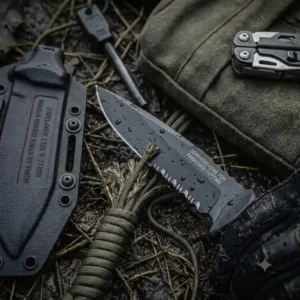
This is my go-to recommendation for maritime operators, kayakers, and fishermen who need a tactical crossover. The partially serrated edge (which I usually despise on bushcraft knives) actually makes sense here. In my field tests, those serrations tore through thick, wet marine rope and nylon zip-ties in a fraction of the time a plain edge took. It is a highly specialized armed force tactical knife built for cutting fibrous materials in terrible conditions.
Priced around the $80-$110 range, user reviews constantly praise its lightweight feel and rust resistance. The most common complaint is the Kydex sheath’s retention mechanism, which can be overly stiff out of the box. But if your primary operational theater involves water, the SEAL Pup Elite is incredibly hard to beat for the money.
✅ Pros: Superb rust resistance, serrations excel on rope/webbing, aggressive grip.
❌ Cons: Factory sheath retention is too tight, not ideal for fine wood carving.
5. Cold Steel SRK (Survival Rescue Knife)
The Cold Steel SRK features SK-5 high carbon steel coated in a black Tuff-Ex finish. SK-5 is equivalent to American 1080 steel—it is incredibly tough, capable of flexing under extreme lateral stress without snapping. In practical terms, you can wedge this knife into a door frame to pry it open, and the blade will survive. The Kray-Ex handle offers a slightly squishy, deeply textured grip that completely absorbs the shock of heavy impacts.
Because it is the standard issue for Navy SEAL BUDS training, people assume it’s an ocean knife. It is not. The SK-5 steel will rust if the Tuff-Ex coating wears off (and it will, during heavy batoning). This is a heavy-duty, brute-force survival tool best suited for desert or woodland environments. What surprised me most during use was the sheer thickness of the spine. At 5mm thick, it splits logs effortlessly, making it the ultimate budget-friendly camp knife.
Hovering in the highly accessible $50-$75 range, the SRK provides the best pound-for-pound durability on this list. Real user feedback is overwhelmingly positive regarding its strength, though many complain that the factory edge can be a bit blunt. If you want an armed force tactical knife that you can unapologetically abuse without crying over the price tag, this is your blade.
✅ Pros: Unbelievably strong SK-5 steel, excellent shock-absorbing handle, budget-friendly.
❌ Cons: Blade coating wears quickly, requires regular oiling to prevent rust.
🔍 Ready to Upgrade Your Tactical Setup?
Optimizing your field gear means investing in tools that can handle unexpected stress, ensuring your safety and efficiency when off the grid. Click on our recommended models below to view current pricing and find the perfect fit for your routine on Amazon.
Practical Usage Guide: First 30 Days with Your Blade
Purchasing a high-quality armed force tactical knife is only step one; your actions in the first 30 days dictate whether it will last a lifetime or fail within a year. Here is a practical roadmap to optimizing and maintaining your new tool.
Step 1: The Initial Sheath Break-In
If your knife comes with a Kydex or hard-molded polymer sheath, it will likely be incredibly stiff. Do not force it. Instead, apply a tiny drop of silicone lubricant to the inside retention points. Insert and draw the knife 50-100 times while watching TV. This naturally wears down the friction points, giving you a smooth, one-handed tactical draw without compromising retention security.
Step 2: The “Year One” Maintenance Cycle
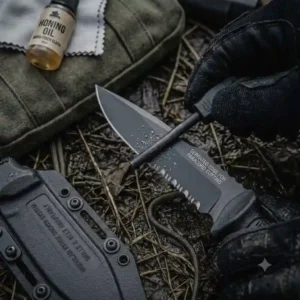
Every blade, even “stainless” steel, requires maintenance. Carbon steel blades (like the KA-BAR and Cold Steel SRK) demand a coat of oil immediately after unboxing. I highly recommend food-safe oils like mineral oil or FrogLube, especially if you plan on slicing food at camp. Apply a thin coat once a week for the first month, allowing the steel’s pores to absorb the protection. For stainless blades (Benchmade, SOG), a quick wipe-down with a dry cloth after use is sufficient, with oiling only needed after heavy rain exposure.
Step 3: Reprofiling the Factory Edge
Most tactical knives arrive with a 25 to 30-degree micro-bevel. This makes the edge durable but terrible for fine tasks like feather-sticking. In your first month, avoid using pull-through carbide sharpeners—they violently tear the steel away. Instead, invest in a leather strop and green polishing compound. Stropping your blade after every heavy use aligns the microscopic burrs, keeping it razor-sharp without removing actual steel.
Real-World Scenarios: Which Blade Fits Your Mission?
Even a “perfect” knife will fail if placed in the wrong environment. Let’s break down three specific user profiles to ensure you aren’t buying the wrong tool for your lifestyle.
Profile A: The Daily Backcountry Commuter (Search & Rescue, Forest Rangers)
-
The Mission: You are traversing rugged terrain daily. You need a blade for emergency shelter construction, processing firewood, and potential wildlife defense.
-
The Match: Gerber StrongArm or Cold Steel SRK.
-
The Reasoning: You need thickness and shock absorption. The SK-5 or 420HC steel can take heavy batoning without chipping. A premium thin blade would snap under the torque of prying apart frozen wood.
Profile B: The Tactical Minimalist (Law Enforcement, Active Military Duty)
-
The Mission: Your gear weighs 45 pounds already. You need a blade for close-quarters emergencies, cutting webbing, or puncturing thick materials quickly.
-
The Match: Benchmade Nimravus 141.
-
The Reasoning: Ounces equal pounds, and pounds equal pain. The Nimravus is skeletonized and ultra-thin, taking up virtually zero space on a duty belt while offering superior edge retention (154CM) for cutting flex-cuffs and seatbelts without dulling.
Profile C: The Coastal Survivalist (Fishermen, Maritime Operations)
-
The Mission: Saltwater, humidity, and constant moisture are your daily realities.
-
The Anti-Recommendation: Do NOT buy the KA-BAR USMC. It will rust shut in its leather sheath within a week.
-
The Match: SOG SEAL Pup Elite.
-
The Reasoning: AUS-8 stainless steel resists salt corrosion brilliantly, and the aggressively textured synthetic handle ensures you maintain your grip when your hands are slick with water or marine oils.
The Buyer’s Decision Framework: Steel Types Explained
To truly understand an armed force tactical knife, you must understand metallurgy. Steel choice dictates everything from how often you sharpen to whether the blade shatters upon hitting a rock.
| Steel Category | Examples | Primary Advantage | Hidden Drawback |
| High Carbon | 1095, SK-5 | Extreme toughness, easy field sharpening | RUST. Requires strict oiling routine. |
| Mid-Tier Stainless | 420HC, AUS-8 | Great corrosion resistance, very affordable | Loses its fine edge fairly quickly. |
| Premium Stainless | 154CM, S30V | Holds an edge for months of hard use | Prone to micro-chipping, hard to sharpen. |
Looking at the table above, the High Carbon steels are best suited for brutal survival tasks, but the hidden drawback of rust means you must calculate the total cost of ownership (buying oils and rust erasers). If you are a beginner who wants a “buy it and forget it” tool, mid-tier stainless provides the safest balance of cost and ease of maintenance.
How to Choose the Right armed force tactical knife
Selecting the proper blade goes far beyond looking at military aesthetics. You must apply a rigorous, feature-based filtering process. According to the structural guidelines provided by military combat knife history, a true tactical knife must meet specific geometric and metallurgical standards.
1. Demand a True Full Tang
If the steel blade does not extend all the way through the handle to the butt of the knife, it is a toy, not a tool. A “rat-tail” tang or partial tang will snap at the handle junction the first time you try to pry something open or baton a log. Always verify full-tang construction.
2. Evaluate Blade Geometry (Drop Point vs. Tanto)
Marketing departments love to push Tanto blades because they look like armor-piercing ninja gear. While Tanto points are excellent for puncturing metal drums or car doors (due to the thick reinforced tip), they are terrible for slicing, carving, or skinning. For 90% of survival and tactical tasks, a classic Drop Point or Clip Point geometry offers vastly superior utility.
3. Analyze Sheath Mounting Options
A knife is completely useless if you can’t comfortably carry it. Your armed force tactical knife should feature a sheath with multiple lashing points, MOLLE compatibility, and ambidextrous retention. If a knife only comes with a cheap nylon belt loop that flops around when you run, you will leave it at home.
Common Mistakes When Buying Combat Fixed Blades
Even experienced outdoorsmen fall into psychological traps when upgrading their gear. Here is my expert commentary on the most frequent pitfalls.
The “Bigger is Better” Myth
Many buyers gravitate toward massive 9-to-11-inch “Rambo” style bowie knives. In practice, carrying a blade that large on your hip is agonizingly uncomfortable. It digs into your ribs when you sit in a vehicle and catches on brush in the woods. A blade length between 4.5 and 6 inches is the sweet spot for an armed force tactical knife. It is long enough to process wood, but nimble enough for fine tasks like trap making.
Obsessing Over Serrations
Unless you are a jumpmaster cutting parachute cord, a maritime operator cutting wet nylon rope, or dealing with excessive webbing daily, skip the serrations. Combo edges (half plain, half serrated) give you the worst of both worlds—too little plain edge for clean wood carving, and a serrated section that is an absolute nightmare to sharpen without specialized rod files.
Ignoring Handle Ergonomics for Aesthetics
Those skeletonized, paracord-wrapped handles look incredible on Instagram. But try chopping hard oak with a paracord-wrapped handle for twenty minutes. The friction will tear your hands to shreds, causing severe hot spots and blisters. A proper tactical blade uses contoured Micarta, G10, or rubberized over-molds that fill the palm and absorb shock.
Long-Term Cost & Maintenance Cycle
The purchase price of an armed force tactical knife is only the beginning of your investment. Calculating the “Total Cost of Ownership” separates the amateurs from the professionals.
If you purchase a high-carbon blade like the KA-BAR, you are committing to a maintenance cycle. Over a three-year period, you will need to invest in quality mineral oil, brass brushes for rust removal, and potentially leather conditioner for the handle. This hidden cost adds up in both time and money.
Conversely, if you purchase a premium steel knife like the Benchmade Nimravus (154CM), you save time on rust prevention, but you face an “efficiency gap” in sharpening. You cannot sharpen 154CM easily with a cheap $10 pocket stone. You will likely need to invest $50-$80 in a diamond-plate sharpening system to successfully reprofile that hardened edge once it finally dulls. Understanding these post-purchase ecosystems ensures you aren’t blindsided by the realities of maintaining tactical gear.
Fixed Blade vs Folding Tactical Options
One of the most heavily debated topics in the gear community is whether a heavy-duty tactical folding knife can replace a fixed blade.
| Feature | Fixed Blade | Tactical Folder |
| Structural Integrity | 100% (No moving parts) | Vulnerable at the pivot point |
| Deployment Speed | Instant (Draw from sheath) | Requires thumb-stud/flipper action |
| Concealability | Low (Requires belt/vest space) | High (Disappears in pocket) |
| Maintenance | Easy to clean | Pivot gets clogged with dirt/sand |
Looking at the comparison above, it becomes obvious why militaries do not issue folding knives as primary combat tools. While a high-end folder is fantastic for opening MREs or everyday carry, its mechanical pivot is a critical point of failure. If sand gets into the bearing system, or if you apply lateral prying pressure, the lock will fail, folding the blade onto your fingers. An armed force tactical knife must be a fixed blade because it removes all mechanical variables from the equation. When your life is on the line, simplicity equals survival.
Safety, Regulations, and Compliance Guide
Before strapping a 6-inch fixed blade to your belt and walking into town, you must understand the legal landscape. The laws governing an armed force tactical knife vary wildly by jurisdiction.
In many U.S. states, carrying a folding knife clipped to your pocket is perfectly legal, but carrying a fixed blade concealed under a jacket is considered a felony (carrying a concealed dirk or dagger). Furthermore, certain features can classify a tool as a restricted weapon. For example, a double-edged dagger profile is completely illegal in multiple states, regardless of blade length.
Always check local ordinances regarding open carry. From a practical standpoint, if you are traveling across state lines for a camping trip, keep your tactical fixed blade locked in a tough box in the trunk, separate from the passenger compartment, to comply with strict transport laws.
Conclusion
Choosing the right armed force tactical knife requires cutting through the aggressive marketing and focusing strictly on metallurgy, geometry, and intended use cases. Whether you opt for the budget-friendly sheer power of the Cold Steel SRK, the modular versatility of the Gerber StrongArm, or the premium precision of the Benchmade Nimravus, your blade is only as good as your commitment to maintaining it.
Remember that a knife is an inherently personal tool. The best blade on the planet is useless if it feels awkward in your hand or if the sheath system prevents you from carrying it comfortably. Assess your environment—be it a humid coastline, a freezing alpine ridge, or a sandy desert—and select the steel that thrives in that ecosystem. Keep your edge honed, oil your carbon steel, and stay sharp out there.
FAQs
❓ What is an armed force tactical knife?
✅ An armed force tactical knife is a fixed-blade cutting tool designed for military, survival, and high-stress utility. It typically features a full-tang construction, durable impact-resistant steel, a non-slip ergonomic handle, and a secure sheath system optimized for modular carry…
❓ Can I baton wood with an armed force tactical knife?
✅ Yes, provided it has a full tang and a blade thickness of at least 3.5mm to 5mm. High-carbon steels like 1095 or SK-5 are best for batoning, as they absorb shock without chipping, whereas extremely hard premium steels might micro-chip under heavy impact…
❓ What is the best steel for an armed force tactical knife?
✅ There is no single “best” steel. High-carbon steels (1095) offer maximum toughness and easy sharpening for survivalists, while stainless steels (AUS-8, 154CM) offer superior rust resistance for maritime operators. Choose based on your specific environmental demands…
❓ Are serrated edges better for combat knives?
✅ Not usually. Serrations excel at cutting fibrous materials like wet rope and seatbelts quickly. However, they limit the blade’s ability to perform clean, precise cuts for wood carving or field dressing, and they are incredibly difficult to sharpen in the field…
❓ How do I maintain my tactical fixed blade?
✅ Clean the blade with fresh water and dry it completely after every use. For carbon steel models, apply a thin coat of food-safe mineral oil weekly to prevent rust. Stropping the edge regularly prevents the need for aggressive, metal-removing sharpening sessions…
Recommended for You
- 5 Best Roll Backpack Picks in 2026 (Tested & Reviewed)
- Best Concealed Carry Bag 2026: 7 Top Rated Packs for Secure Safety
- 5 Top-Rated third day bag Options for 2026: Expert Field Tests & Reviews
Disclaimer: This article contains affiliate links. As an Amazon Associate, I earn from qualifying purchases. If you purchase products through these links, we may earn a small commission at no additional cost to you.
✨ Found this guide helpful? Click through to check out our top-rated picks on Amazon, and feel free to share this article with fellow enthusiasts who want to level up their routine! 💬🤗
[addtoany]
